 High Bay LED Lighting
 Industrial Low Bay Lighting
 Industrial Strip Lights
 Vapor Tight Lighting
 LED Shop Lights
 LED Ready Fixtures
 Hazardous Area / Explosion Proof Lighting
 Loading Dock Lights
 Construction / Portable Lighting
 High Temperature LED Lights
 Industrial Ceiling Fans
 LED Work Lights
 Networked Controlled Lighting
 American Made Industrial Lighting
 Clearance
 Troffer Lights
 LED Flat Panel Lights
 Drop Ceiling Lights
 LED Ready Troffers
 Suspended LED Lights
 LED Cylinder Lights
 Stairway & Corridor Lighting
 Hospital Bed Lights
 Wrap Lighting Fixtures
 Gooseneck and Barn Lights
 Commercial Sign Lights
 LED Track Lighting Fixtures & Systems
 Recessed Lighting
 Wafer Lighting
 RGB LED Lights
 Exit / Emergency
 Refrigeration Lighting
 Grow Lights
 UV Disinfecting Lights & Air Purifier Fixtures
 American Made Commercial Lighting
 LED Flood Lights
 Outdoor Wall Lights
 LED Area Lights
 Parking Lot Lights & Poles
 Outdoor Post Top Lights
 LED Stadium Lighting
 Canopy Lights
 Security & Motion Sensor Lights
 LED Bollard Lights
 Outdoor Barn Lights
 Solar Powered LED Lighting
 Dusk to Dawn Lights
 Landscape Lighting
 Outdoor String Lights
 Coastal Wildlife Lighting
 Outdoor House Lights
 American Made Outdoor Lighting
 Architectural Linear Lights
 Architectural Grid Mount Lights
 Architectural Round Pendant Lights
 Architectural Square Linear Lights
 Architectural X-Shaped Linear Lights
 Architectural LED Wall Packs
 Ceiling Fans
 Ceiling Lights
 Chandelier Lights
 Pendant Lighting
 Island Lights
 Under Cabinet Lighting
 Vanity Lights
 Wall Sconces
 LED Tape Lights
 LED Mirrors
 LED Light Bulbs
 LED Tube Lights
 LED Corn Lights
 Vintage LED Bulbs
 Decorative LED Bulbs
 Fluorescent Light Bulbs
 Metal Halide Lamps
 LED Magnetic Strip Retrofit Kits
 LED Strip Light Retrofit Kits
 High Bay LED Retrofit Kits
 LED Troffer Retrofit Kits
 LED Wall Pack Retrofit
 LED Street Light Retrofit Kits
 Recessed Lighting LED Retrofit Kits
 WareSense Blue - Bluetooth Control System
 Ballasts & Drivers
 Emergency Ballast For LED & Fluorescent Lights
 Electrical Supplies & Mounting Kits
 Electrical Tools
 Switches & Receptacles
 Electrical Power Cords
 Sensors and Timers
 Smart Home Automation
 High Bay Occupancy Sensors
 Electric Vehicle Chargers
 Hand Dryers
 LED Shop Lights
 Garage LED Lighting
 Gym Lighting
 Factory Lights
 Restaurant Lights
 Office Lights
 Classroom Lights
 Church Lights
 Warehouse Lights
 Hospital Lights
 Walkway Lights
 Parking Lot Lights
 Exterior Building Lights
 Sports Lighting
 Airport Lights
 NSF Rated Lights
 TAA LED Lighting
 Corridor Lights
 Barn Lighting
 Multi-Family Lighting Solutions






Where to Start With a Church Lighting Project
Church lighting has to do more work than almost any other commercial space. One room hosts quiet prayer, a sermon that needs every eye forward, a music set, a wedding, and a Tuesday night committee meeting — often in the same week.
Add sloped seating, vaulted ceilings, stained glass, a video stream, and a fixed budget, and it becomes clear why so many churches end up with lighting that fights the room instead of serving it. This guide walks through how contractors and building committees actually approach a church lighting project: what drives fixture selection, where the code requirements sit, and which decisions cause the most expensive regrets.
What This Guide Covers
Jump to the section you need:
- Start with ceiling height, not fixture style
- Light the sanctuary for reading first
- Make the platform the focal point
- If you stream services, light for the camera
- Color temperature and color rendering
- Dimming and controls: where projects go wrong
- Narthex, fellowship hall, and classrooms
- Exterior lighting and evening arrival
- Egress and emergency lighting requirements
- Retrofitting an older church
- Frequently asked questions
Start With Ceiling Height, Not Fixture Style
The single most useful number on a church lighting project is the mounting height above the finished floor. It narrows the fixture list faster than any aesthetic decision, and getting it wrong is what produces dim sanctuaries and glare complaints.
- Under 12 feet — fellowship halls, classrooms, offices, and smaller chapels. Recessed downlights, drop ceiling fixtures, and surface-mount cylinder lights all work here.
- 12 to 20 feet — the most common sanctuary range. Suspended linear fixtures, larger-aperture downlights, and low bay fixtures deliver the output without the harsh punch of a narrow high-bay beam.
- Above 20 feet — vaulted and cathedral ceilings. High bay fixtures or narrow-beam downlights with higher lumen packages, often pendant-mounted on aircraft cable or rod.
There is a second question that matters just as much and gets asked far too late: how will anyone reach these fixtures again? A 32-foot vaulted ceiling means a lift, scaffolding over pews, or a scissor lift that will not fit through the door. Long-life LED fixtures rated for 50,000 hours or more turn a recurring access problem into a once-a-decade one, which is often the strongest argument for the upgrade in the first place.
Light the Sanctuary for Reading First
Congregants read. Hymnals, bulletins, printed liturgy, small-print Bibles, and increasingly their own phones. If the seating area is lit only for atmosphere, the complaints arrive within a week of the ribbon cutting — and they come from the people least able to compensate for low light.
Most designers target roughly 20 to 30 footcandles on the seating plane where printed material is in regular use, then dim well below that for portions of the service that call for lower light. Design for the higher number and dim down; you cannot dim up past what the fixtures can deliver.
Two details separate a comfortable sanctuary from an uncomfortable one:
- Uniformity across the seating. Pools of bright light with dark gaps between them read as dim even when average levels measure fine. Tighter fixture spacing with lower output per fixture almost always beats fewer, brighter fixtures.
- Glare control toward the platform. Everyone in the room spends the service looking forward and slightly up. Any fixture in that sightline needs shielding, a recessed aperture, or a lens that cuts direct view of the diode. This is the most common single complaint after a retrofit, and it is largely preventable at the specification stage.
Older congregations need more light than the standard numbers suggest — visual acuity and contrast sensitivity both decline with age. If your congregation skews older, plan toward the top of the range rather than the middle.
Make the Platform the Focal Point
Attention follows brightness. The platform, chancel, altar, or pulpit should read as clearly brighter than the seating area — most designers work toward roughly three times the surrounding level, which the eye reads as "this is where to look" without anyone consciously noticing why.
A single fixture over the pulpit will not do it. One light source from one direction produces hard shadows under the brow, nose, and chin, and it flattens everything behind the speaker.
- Light from at least two directions. A key light from the front at roughly a 45-degree angle, plus a softer fill from the opposite side, keeps facial features readable without harsh shadow. Larger platforms need three or four positions.
- Keep fixtures out of the speaker's eyes. Mount above and forward of the focal point so the beam angles down onto the face rather than into it. A speaker squinting through the sermon is a lighting failure.
- Choose adjustable fixtures. Track lighting is the workhorse here because the platform layout will change — Christmas, Easter, baptisms, weddings, a guest choir. Fixed downlights aimed at last year's pulpit position age badly. For larger sanctuaries, flood lights and spotlights carry the throw distance that track heads cannot.
If there is a projection screen or LED wall behind the platform, keep light off it. Spill onto a screen washes out contrast and makes the display look broken, and no amount of projector brightness fixes it. Aim tightly, use shielding, and put the screen area on its own control zone.
If You Stream Services, Light for the Camera
Cameras are far less forgiving than eyes, and any church that streams or records has effectively added a second, stricter client to the project. Three specifications matter more than they would otherwise:
- More light on faces. Cameras need considerably more illumination than the human eye to produce a clean image without noise, particularly the fixed-lens cameras common in worship installations. Platform levels that look generous in person often read as murky on the stream.
- High color rendering. A CRI of 80 is acceptable for general spaces, but 90 or higher belongs anywhere skin tones, vestments, wood, or stained glass appear on camera. Low-CRI light makes faces look gray or sallow in a way that no color correction fully repairs.
- Flicker-free drivers. This is the specification most often missed. Inexpensive LED drivers produce ripple that a camera sensor captures as banding, rolling bars, or a strobe effect — invisible in the room, obvious on the recording. Ask specifically about flicker performance before ordering, and test one fixture on camera before committing to a full order.
Consistency also matters more on camera than in person. Mixing color temperatures within a single camera shot produces a color cast the eye forgives and the sensor does not.
Color Temperature and Color Rendering
Color temperature sets the character of the room, and in a worship space that decision carries more weight than it would in a warehouse.
- 2700K to 3000K suits traditional sanctuaries with wood pews, stone, plaster, and stained glass. It reads as warm and close to the incandescent light most historic churches were designed around.
- 3500K to 4000K suits contemporary and multipurpose rooms, fellowship halls, and classrooms, where the space needs to feel alert rather than intimate.
- Above 4000K rarely belongs in a sanctuary. It reads clinical against warm architectural materials, and it is the fastest way to make a congregation feel that the character of the room has been lost.
Whichever you choose, hold one color temperature per zone and avoid mixing within a single sightline. Two nominally identical fixtures from different production runs can also differ visibly; specifying tight binning tolerance matters when fixtures sit side by side in an exposed ceiling.
A note specific to churches: interior lighting will wash out stained glass after dark, because the glass reads by transmitted light. If the windows matter to the congregation, plan exterior backlighting so they remain visible from outside during evening services — it is one of the highest-impact, lowest-cost moves available on a church lighting project.
Dimming and Controls: Where Projects Go Wrong
Dimming is not an upgrade on a church project. It is the mechanism that lets one room serve a dozen purposes, and it is also where the most expensive mistakes happen.
- Verify driver and dimmer compatibility before ordering. Commercial installations generally use 0-10V or DALI control; smaller projects sometimes use ELV or TRIAC. Mismatched combinations produce flicker, buzzing, dropout at low levels, or fixtures that simply refuse to dim. Get the manufacturer's compatibility list and test one fixture with the actual dimmer before buying two hundred.
- Check the low end of the dimming range. A driver rated to 10% is very different from one rated to 1%. If services call for near-dark, that number is the specification that determines whether you get it.
- Build scenes, not sliders. Volunteers run the lights on most Sunday mornings. Preset scenes — full service, sermon, music, cleaning, empty building — are what make the system usable by someone who was not in the commissioning meeting.
- Use occupancy sensors where nobody is watching. Classrooms, restrooms, offices, and corridors are lit far more hours than they are occupied. This is where a church's energy savings actually accumulate.
Where the sanctuary has substantial daylight from clear windows or skylights, daylight harvesting is worth pricing. Where the daylight arrives through stained glass, be cautious — colored light confuses many photosensors.
Narthex, Fellowship Hall, and Classrooms
Church lighting budgets concentrate on the sanctuary, and the rest of the building is where congregations actually notice the difference day to day.
- Narthex and lobby. This space manages the transition from bright daylight or dark parking lot into a dimmer sanctuary. Light it between the two, and the eye adapts without the cave effect that makes a sanctuary feel gloomy on entry.
- Fellowship hall. A genuinely multipurpose room: meals, meetings, receptions, children's programs, and cleanup. It needs higher levels than a sanctuary and dimming for events. Drop ceiling fixtures and flat panels cover most installations, with 3500K to 4000K appropriate here.
- Classrooms and Sunday school. Task-level light with good uniformity for reading and craft work. Flat panels and troffers at 4000K, with occupancy sensors given how intermittently these rooms are used.
- Corridors and stairwells. Often the oldest lighting in the building and the most safety-relevant. Stairwell fixtures designed for continuous operation and code-required levels belong here rather than whatever fits the existing box.
Exterior Lighting and Evening Arrival
Most churches host evening activities year-round, and in winter the entire arrival and departure happens in the dark. Exterior lighting is a safety system as much as an aesthetic one.
- Parking areas. Pole-mounted area lights provide the uniform coverage that building-mounted fixtures cannot reach. Uniformity matters more than peak brightness — dark patches between bright pools are where people trip.
- Building perimeter and entries. Wall packs cover service doors and secondary entrances. The main entrance deserves better than a wall pack, since it is the first thing visitors see.
- Walkways and steps. Every change in elevation between parking and door needs light on it. Churches skew toward older congregations, and this is where falls happen.
- Facade and architectural lighting. Flood lights aimed at a steeple, bell tower, or entrance make the building legible from the road at night.
Check local dark-sky and light-trespass ordinances before specifying exterior fixtures, particularly where the church sits in a residential neighborhood. Full-cutoff optics and appropriate BUG ratings keep light on the property and complaints off the agenda. Photocell and time-clock control avoids the common situation of a parking lot lit at three in the morning.
Egress and Emergency Lighting Requirements
Churches are assembly occupancies, and that classification brings emergency lighting requirements that are not optional and are frequently the reason a project fails inspection.
- Illuminated means of egress. Codes generally require the egress path to remain illuminated for 90 minutes after a power loss, with minimum levels maintained at floor level along the entire route — aisles, corridors, stairs, and the path to the exit discharge. Emergency fixtures with integral battery backup are the usual approach.
- Exit signs. Illuminated exit signs at required locations, also on backup power.
- Testing and documentation. Emergency systems require periodic testing, and inspectors ask for records. Self-testing fixtures reduce the burden on a volunteer facilities team considerably.
Requirements vary by jurisdiction, occupancy load, and whether the work is new construction or an alteration to an existing building — and historic structures sometimes carry additional constraints. Confirm specifics with your local authority having jurisdiction and a licensed electrician before finalizing a design. This is not a section to work out from a product page.
Retrofitting an Older Church
Most church lighting projects are not new construction. They are replacements of aging metal halide, fluorescent, or incandescent systems in a building that may be a century old, where the fixtures themselves are sometimes part of what the congregation values.
- Retrofit kits versus full replacement. Where existing housings are architecturally significant — historic pendants, chandeliers, decorative sconces — retrofit kits keep the fixture and replace the light source. Where housings are ordinary, full replacement usually costs less per fixture and performs better.
- Expect wiring surprises. Older buildings hide undocumented circuits, deteriorated insulation, and ballast wiring that does not match any drawing. Budget contingency, and have an electrician survey before quantities are final.
- Check utility rebates early. Commercial lighting rebates are common and can materially change project economics, but most programs require DLC-listed products and pre-approval before installation. Applying after the work is done usually forfeits the money.
- Phase it if the budget requires. Sanctuary first, then fellowship hall and classrooms, then exterior. Just specify the whole project up front so phase three still matches phase one — buying the same color temperature and finish two years later is much easier when it was written down.
For a look at how this plays out in a real building, see our case study on how LED lighting transformed a historic house of worship.
Not Sure Where to Start? Send Us Your Floor Plan
Church projects have too many variables to solve from a product page. Our team will review your dimensions, ceiling heights, and seating layout and come back with a fixture list and layout at no cost.
Frequently Asked Questions About Church Lighting
Below are the questions we field most often from churches, contractors, and building committees. If your situation is not covered here, our lighting specialists are glad to talk it through.
What color temperature is best for a church sanctuary?
Most traditional sanctuaries look best at 2700K to 3000K, which stays close to the warm incandescent light the building was likely designed around and complements wood, stone, and stained glass. Contemporary and multipurpose rooms often use 3500K to 4000K. Anything above 4000K tends to read as clinical in a worship space. Hold one color temperature per zone rather than mixing within a single sightline.
How bright should church lighting be?
Where congregants read hymnals or printed bulletins, designers commonly target roughly 20 to 30 footcandles on the seating plane, with the platform noticeably brighter so attention naturally moves forward. Design for the higher level and dim down, since you cannot dim above what the fixtures deliver. Congregations that skew older generally need levels toward the top of that range.
What kind of lighting works for a church with high vaulted ceilings?
Above roughly 20 feet, high bay fixtures or narrow-beam downlights with higher lumen packages carry the throw distance required, typically pendant-mounted on aircraft cable or rod. The bigger planning question is maintenance access: at that height, replacing a fixture means a lift and often work over fixed seating, which is why long-life LED fixtures rated for 50,000 hours or more are worth the premium.
Do we need special lighting if we stream our services?
Yes. Cameras need more light on faces than the eye does, a CRI of 90 or higher to render skin tones and vestments accurately, and flicker-free drivers. Flicker is the specification most often missed — inexpensive drivers produce ripple that is invisible in the room but shows up as banding or rolling bars on the recording. Test one fixture on your actual camera before ordering the full quantity.
Is emergency lighting required in a church?
Churches are assembly occupancies, and codes generally require illuminated means of egress that remains lit for 90 minutes after a power loss, along with illuminated exit signs on backup power. Specific requirements depend on your jurisdiction, occupancy load, and whether the work is new construction or an alteration, and historic buildings can carry additional constraints. Confirm the details with your local authority having jurisdiction and a licensed electrician.
Can we keep our historic light fixtures and still convert to LED?
Often yes. Where existing pendants, chandeliers, or sconces are part of the building's character, retrofit kits replace the light source while keeping the housing. Where housings are ordinary, full replacement usually costs less per fixture and performs better. Have an electrician survey the existing wiring first — older buildings routinely hide undocumented circuits and deteriorated insulation.
Are there rebates available for church lighting upgrades?
Commercial lighting rebates are common through local utilities and can meaningfully change project economics. Most programs require DLC-listed products and pre-approval before installation, so check availability before you order rather than after the work is finished. We can confirm which of our fixtures carry the listings your utility requires.
Shop LED Church Lighting at Warehouse-Lighting.com
Warehouse-Lighting.com supplies the full range of fixtures a church project calls for — downlights and cylinders for the sanctuary, suspended and high bay fixtures for vaulted ceilings, track and flood lighting for the platform, flat panels for classrooms and fellowship halls, emergency and exit lighting for code compliance, and pole and wall-mounted fixtures for the parking lot and perimeter.
Browse our LED church lighting selection, or talk to our team about specifying a full church project from the sanctuary out to the property line.

Case Study: How LED Church Lighting Transformed a Historic House of Worship
How a historic church replaced 112 aging metal halide, incandescent and fluorescent fixtures with LED architectural cylinders, dimmable recessed downlights and flat panels — zone by zone at 3000...
Read Article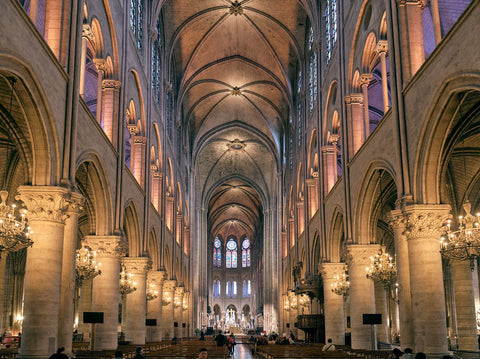
Cathedral Lighting
We break down how to make the most of cathedral lighting for your unique location. From placement to fixture type, find out all the basics.
Read Article
Auditorium Lighting
An audience gives little thought to auditorium lighting, but as a contractor, building owner, or stage manager, you know how important lighting is to your venue. Choosing the right auditorium light...
Read Article

