High Bay LED Lighting
 Industrial Low Bay Lighting
 Industrial Strip Lights
 Vapor Tight Lighting
 LED Shop Lights
 LED Ready Fixtures
 Hazardous Area / Explosion Proof Lighting
 Loading Dock Lights
 Construction / Portable Lighting
 High Temperature LED Lights
 Industrial Ceiling Fans
 LED Work Lights
 Networked Controlled Lighting
 American Made Industrial Lighting
 Clearance
 Troffer Lights
 LED Flat Panel Lights
 Drop Ceiling Lights
 LED Ready Troffers
 Suspended LED Lights
 LED Cylinder Lights
 Stairway & Corridor Lighting
 Hospital Bed Lights
 Wrap Lighting Fixtures
 Gooseneck and Barn Lights
 Commercial Sign Lights
 LED Track Lighting Fixtures & Systems
 Recessed Lighting
 Wafer Lighting
 RGB LED Lights
 Exit / Emergency
 Refrigeration Lighting
 Grow Lights
 UV Disinfecting Lights & Air Purifier Fixtures
 American Made Commercial Lighting
 LED Flood Lights
 Outdoor Wall Lights
 LED Area Lights
 Parking Lot Lights & Poles
 Outdoor Post Top Lights
 LED Stadium Lighting
 Canopy Lights
 Security & Motion Sensor Lights
 LED Bollard Lights
 Outdoor Barn Lights
 Solar Powered LED Lighting
 Dusk to Dawn Lights
 Landscape Lighting
 Outdoor String Lights
 Coastal Wildlife Lighting
 Outdoor House Lights
 American Made Outdoor Lighting
 Architectural Linear Lights
 Architectural Grid Mount Lights
 Architectural Round Pendant Lights
 Architectural Curved LED Linear Lights
 Architectural Square Linear Lights
 Architectural X-Shaped Linear Lights
 Architectural LED Wall Packs
 Ceiling Fans
 Ceiling Lights
 Chandelier Lights
 Pendant Lighting
 Island Lights
 Under Cabinet Lighting
 Vanity Lights
 Wall Sconces
 LED Tape Lights
 LED Mirrors
 LED Light Bulbs
 LED Tube Lights
 LED Corn Lights
 Vintage LED Bulbs
 Decorative LED Bulbs
 Fluorescent Light Bulbs
 Metal Halide Lamps
 LED Magnetic Strip Retrofit Kits
 LED Strip Light Retrofit Kits
 High Bay LED Retrofit Kits
 LED Troffer Retrofit Kits
 LED Wall Pack Retrofit
 LED Street Light Retrofit Kits
 Recessed Lighting LED Retrofit Kits
 WareSense Blue - Bluetooth Control System
 Ballasts & Drivers
 Emergency Ballast For LED & Fluorescent Lights
 Electrical Supplies & Mounting Kits
 Electrical Tools
 Switches & Receptacles
 Electrical Power Cords
 Sensors and Timers
 Smart Home Automation
 High Bay Occupancy Sensors
 Electric Vehicle Chargers
 Hand Dryers
 LED Shop Lights
 Garage LED Lighting
 Gym Lighting
 Factory Lights
 Restaurant Lights
 Office Lights
 Classroom Lights
 Church Lights
 Warehouse Lights
 Hospital Lights
 Walkway Lights
 Parking Lot Lights
 Exterior Building Lights
 Sports Lighting
 Airport Lights
 NSF Rated Lights
 TAA LED Lighting
 Corridor Lights
 Barn Lighting
 Multi-Family Lighting Solutions



Doctor's Office Lighting

Lighting does more work in a medical practice than in most commercial spaces. It has to give clinicians enough accurate light to examine patients, while keeping the rest of the building from feeling clinical to people who are already anxious about being there. Those two goals pull in opposite directions, which is why a single lighting spec applied throughout a practice rarely works. Here is how to approach doctor's office lighting room by room.
1. Get the Color Temperature Right
Color temperature matters more here than almost anywhere. Too warm and the practice reads as dingy and dated. Too cool and it feels harsh and institutional, which is the last thing a nervous patient needs.
Avoid the extremes. As a general rule, 3500K gives a warmer, more welcoming feel and suits reception and waiting areas, while 4000K reads cleaner and more modern and works well in corridors and general practice areas. Exam rooms can go slightly cooler still, where clinicians need to see accurately.
Fixtures with selectable color temperature are worth considering for a practice being fitted out in stages, since one part number covers several rooms set differently.
2. Keep the Waiting Room Dimmer Than You Think
This is the most common mistake in medical lighting. Practices often specify the brightest fixture available throughout, and the waiting room ends up uncomfortable. Patients frequently report more stress waiting than they do in the exam room itself, and harsh overhead light does not help.
Opt for lower lumen output in waiting areas. Not dark or uninviting, but noticeably softer than the clinical spaces. Pairing that with dimming controls gives you room to adjust once the space is in use and you can see how it actually feels.
3. Use Natural Light Where You Have It
Where a waiting area has decent windows, let that daylight lead and treat the artificial lighting as fill rather than the primary source. Daylight helps with patient comfort and with staff mood over a long shift. Match your fixture color temperature to the daylight coming in so the two do not fight each other at the edges of the day.
4. Position Fixtures to Avoid Glare
Anything mounted below eye level will create glare or distraction. Overhead lighting is the right default for a practice because it distributes evenly and stays out of sightlines.
That said, a ceiling grid alone reads flat. Wall sconces with an uplight component soften the room considerably, and suspended fixtures over a reception desk give that area some definition without adding glare.
5. Specify Diffused Fixtures
A diffuser spreads the light across the face of the fixture instead of letting the diodes show through as bright points. That is what lets you hit the light level you need without the fixture itself becoming uncomfortable to sit under.
Frosted LED flat panels and lensed troffers both handle this well and are the two most common fixtures in medical fit-outs.
6. Light Each Area for What Happens In It
A practice is several different lighting environments under one roof:
- Reception and waiting: warmer, lower output, diffused. Comfort over clarity.
- Corridors: even coverage, neutral temperature, no dark patches between fixtures.
- Exam rooms: cooler and brighter, with high CRI so skin tone and coloring read accurately. This is the one place where clinical accuracy beats atmosphere.
- Procedure and treatment rooms: higher output again, and worth checking against any specialty-specific requirements for the work being done.
- Staff and back office: treat as ordinary office space — neutral, comfortable for screen work.
High CRI deserves particular attention in exam rooms. Assessing skin tone, pallor or a rash under poor color rendering makes a clinician's job harder, and it is a spec that costs little to get right at order time.
7. Choose LED Over Fluorescent
For any practice still running fluorescent, LED wins on every measure that matters here: higher output per watt, no flicker, no warm-up, even color across the room, and far longer life. That last point counts for more in a medical setting than most, because re-lamping means working in an occupied clinical space.
Fluorescent is also being phased out. Several states have restricted lamp sales, so replacement tubes will get harder to source over the life of the fixture. If you are opening up a ceiling anyway, replace the fixture rather than re-lamp it — recessed downlights and flat panels are the usual replacements.
8. Mix Fixture Types
No single fixture does the whole job. A practice lit entirely with one product looks flat regardless of how good that product is. Recessed or panel fixtures for the ambient layer, sconces for warmth at the edges, and something with presence over reception is a reliable starting scheme.
Planning a Medical Practice Fit-Out?
Our lighting specialists can help you zone a practice by room, pick high-CRI fixtures for exam spaces, confirm dimmer compatibility, and run a free photometric layout before you order.
SHOP OFFICE & MEDICAL LIGHTING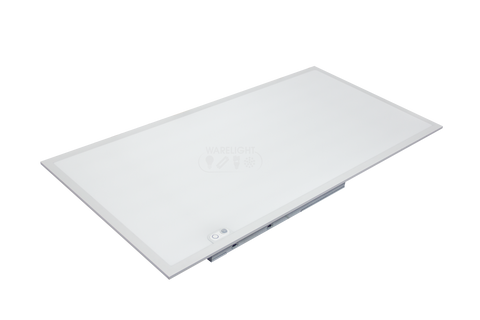
2 x 4 Foot Back Lit LED Flat Panel, 9000 Lumen Max, Selectable Wattage and CCT, Dimmable, 120-277V

2 x 2 Foot Back Lit LED Flat Panel, 5000 Lumens, Selectable Wattage and CCT, Dimmable, 120-277V



Buy flat-panel LED lights at Warehouse-Lighting.com. Our LED flat-panel light fixtures are backed by 1,500 verified reviews from satisfied customers. Order flat-panel lights today and take advantage of our free resources.
View (106) Products
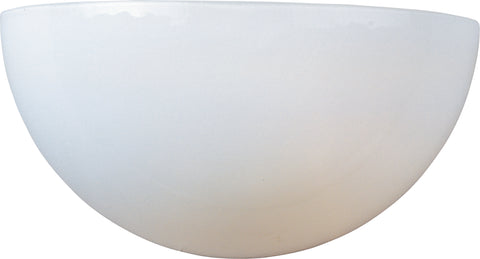
Diffusing light up or down to create great ambiance and atmosphere, sconce lighting is highly popular in many applications. Get a beautiful look with these fixtures!
View (142) Products
Shop LED troffer light fixtures in 1x4, 2x2, 2x4, and volumetric styles for offices, schools, and commercial spaces. Energy-efficient recessed lighting.
View (102) Products
Dental Office Lighting
Lighting is one of the most important ways to achieve a safe and inviting atmosphere. A dental office is certainly a location in need of such calming light. When it comes to lighting in dental offi...
Read Article
Best Types of Different Office Lighting Fixtures
For help choosing between different types of office lighting, here are a few tips to guide you. Find the right solution for your space!
Read Article