 High Bay LED Lighting
 Industrial Low Bay Lighting
 Industrial Strip Lights
 Vapor Tight Lighting
 LED Shop Lights
 LED Ready Fixtures
 Hazardous Area / Explosion Proof Lighting
 Loading Dock Lights
 Construction / Portable Lighting
 High Temperature LED Lights
 Industrial Ceiling Fans
 LED Work Lights
 Networked Controlled Lighting
 American Made Industrial Lighting
 Clearance
 Troffer Lights
 LED Flat Panel Lights
 Drop Ceiling Lights
 LED Ready Troffers
 Suspended LED Lights
 LED Cylinder Lights
 Stairway & Corridor Lighting
 Exit / Emergency
 Wrap Lighting Fixtures
 Gooseneck and Barn Lights
 Commercial Sign Lights
 LED Track Lighting Fixtures & Systems
 Recessed Lighting
 Wafer Lighting
 RGB LED Lights
 Hospital Bed Lights
 Refrigeration Lighting
 Grow Lights
 UV Disinfecting Lights & Air Purifier Fixtures
 American Made Commercial Lighting
 LED Flood Lights
 Outdoor Wall Lights
 LED Area Lights
 Parking Lot Lights & Poles
 Outdoor Post Top Lights
 LED Stadium Lighting
 Canopy Lights
 Security & Motion Sensor Lights
 LED Bollard Lights
 Outdoor LED Linear Light Fixtures
 Solar Powered LED Lighting
 Dusk to Dawn Lights
 Landscape Lighting
 Outdoor String Lights
 Coastal Wildlife Lighting
 Outdoor House Lights
 American Made Outdoor Lighting
 Architectural Linear Lights
 Architectural Grid Mount Lights
 Architectural Round Pendant Lights
 Architectural Square Linear Lights
 Architectural X-Shaped Linear Lights
 Architectural LED Wall Packs
 Ceiling Fans
 Ceiling Lights
 Chandelier Lights
 Pendant Lighting
 Island Lights
 Under Cabinet Lighting
 Vanity Lights
 Wall Sconces
 LED Tape Lights
 LED Mirrors
 LED Light Bulbs
 LED Tube Lights
 LED Corn Lights
 Vintage LED Bulbs
 Decorative LED Bulbs
 Fluorescent Light Bulbs
 Metal Halide Lamps
 LED Magnetic Strip Retrofit Kits
 LED Strip Light Retrofit Kits
 High Bay LED Retrofit Kits
 LED Troffer Retrofit Kits
 LED Wall Pack Retrofit
 LED Street Light Retrofit Kits
 Recessed Lighting LED Retrofit Kits
 WareSense Blue - Bluetooth Control System
 Ballasts & Drivers
 Emergency Ballast For LED & Fluorescent Lights
 Electrical Supplies & Mounting Kits
 Electrical Tools
 Switches & Receptacles
 Electrical Power Cords
 Sensors and Timers
 Smart Home Automation
 High Bay Occupancy Sensors
 Electric Vehicle Chargers
 Hand Dryers
 LED Shop Lights
 Office Lights
 Classroom Lights
 Church Lights
 Gym Lighting
 Factory Lights
 Hospital Lights
 Walkway Lights
 Parking Lot Lights
 Exterior Building Lights
 Sports Lighting
 Airport Lights
 Garage LED Lighting
 NSF Rated Lights
 TAA LED Lighting
 Restaurant Lights
 Corridor Lights
 Barn Lighting



Quick Answer: High Bay vs. Low Bay Lights
The main difference is ceiling height. High bay lights are designed for ceilings 20–40 feet high and deliver high lumen output with a focused, narrow beam to reach the floor effectively. Low bay lights are designed for ceilings under 20 feet and spread light more broadly with lower lumen output suited to smaller, more intimate spaces.
- Choose high bay for warehouses, factories, convention centers, and large retail spaces.
- Choose low bay for workshops, restaurants, parking garages, storage units, and fabrication shops.
- The dividing line is typically 20 feet of ceiling height — above that, go high bay; below that, go low bay.
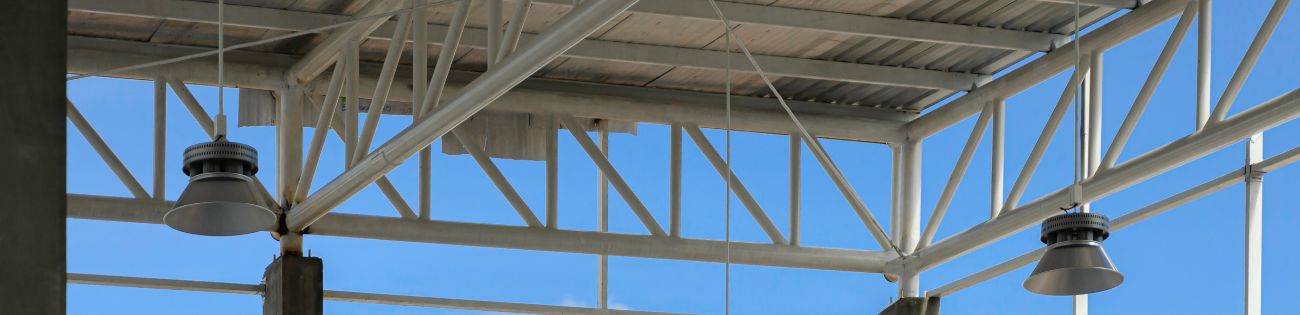
What Is a High Bay Light?
High bay lighting is used in large spaces with 20- to 40-foot ceiling heights. What a high bay light does is provide powerful illumination to vast areas from a significant height, ensuring even light distribution without casting shadows or creating dark spots. Furthermore, when you choose high bay lighting with LED technology, you get superior illumination that's durable and energy efficient. High bay LED lighting reduces energy costs and increases the longevity of your lighting solution.
High bay lights are commonly seen in:
- Warehouses
- Manufacturing Plants
- Convention Centers
- Large Recreational Facilities
- Factories
- Grocery Stores
- Machine Shops
- Big-Box Retailers
What Is a Low Bay Light?
On the other hand, low bay lighting is tailored for spaces with ceiling heights of 20 feet or less. What a low bay light is designed to do is provide a concentrated light spread that illuminates smaller, more confined areas without overwhelming the space with too much brightness or causing glare. Incorporating LED low bay lighting into these spaces can significantly enhance light quality, reduce energy consumption and improve overall visibility.
A low bay fixture is the most common type of ceiling light seen in:
- Public Buildings
- Restaurants
- Hospitality Facilities
- Hospitals
- Homes
- Storage Units
- Parking Garages
- Fabrication Shops
Difference Between High Bay and Low Bay Lights
The primary difference between high bay and low bay lights lies in their application for varying ceiling heights and areas.
Feature |
High Bay Lights |
Low Bay Lights |
Ceiling Height |
Ideal for 20–40 feet: Best for large spaces with high ceilings, requiring concentrated light for expansive areas. |
Ideal for Under 20 feet: Best for smaller areas, offering broader, diffused light suited for lower ceilings. |
Light Direction & Beam Angle |
Focused downward with narrow beam angle: Uses reflectors or lenses to concentrate light downward, directing it over large, high-ceilinged spaces with minimal light spill. |
Wider beam angle, diffused light: Spreads light more evenly across a smaller area, providing softer illumination ideal for lower-ceilinged spaces. |
Lumen Output |
Higher lumen output: Necessary to illuminate large areas with high ceilings, ensuring brightness across expansive zones. |
Lower lumen output: Sufficient for smaller spaces, providing even light without overwhelming intensity. |
Light Distribution |
Minimizes shadows, ensures even brightness: Designed for large spaces, providing uniform lighting and eliminating dark spots. |
Uses diffusers: Diffusers reduce harsh reflections, making the light softer and more pleasant, especially in intimate settings. |
Comfort & Atmosphere |
Bright, powerful illumination: Ideal for industrial or large environments, offering clear visibility and preventing dim areas. |
Softer, inviting light: Creates a comfortable, warm atmosphere, perfect for professional or home settings. |
Mounting Options |
Flexible mounting: Can be hung using chains, pendants, or mounted directly to the ceiling for customizable height and positioning. |
Closer to the ceiling: Typically mounted with brackets or surface-mounted, optimizing light distribution in compact spaces. |
Fixture Placement |
Spaced evenly: Fixtures must be strategically placed to ensure even distribution, avoiding dark spots and maximizing light coverage. |
Focused placement: Fixtures are placed to focus on task areas, ensuring proper lighting for specific needs. |
Retrofit Kits: Enhancing Existing High Bay and Low Bay Lighting Systems
Retrofit kits present a valuable solution for upgrading existing high bay or low bay lighting systems to more energy-efficient and high-performing LEDs. These kits are designed to repurpose and enhance existing fixtures, making them a cost-effective and environmentally friendly choice for improving lighting quality and reducing energy consumption.
- Energy Efficiency: Retrofit kits for LEDs significantly reduce energy usage compared to traditional lighting solutions, such as HID or fluorescent lights. This transition to LED lighting can substantially save energy costs over time.
- Improved Lighting Quality: LED retrofit kits offer superior light quality, including better color rendering and more uniform light distribution.
- Extended Lifespan: LEDs enjoy a longer lifespan than traditional lighting options, which means less frequent replacements and reduced maintenance costs.
- Versatility and Customization: Retrofit kits come in various designs and specifications, allowing for customization based on the specific needs of a space.
- Environmental Impact: By upgrading to more energy-efficient lighting through retrofitting, businesses can significantly reduce their carbon footprint.
Frequently Asked Questions: High Bay vs. Low Bay Lights
What is the difference between high bay and low bay lighting?
The key difference is ceiling height. High bay lights are designed for ceilings 20–40 feet high and produce high lumen output with a focused beam. Low bay lights are designed for ceilings under 20 feet and distribute light more broadly with lower lumen output. High bay fixtures are typically used in warehouses and factories; low bay fixtures in workshops, restaurants, and retail spaces.
When should I use high bay lights instead of low bay?
Use high bay lights any time your ceiling height exceeds 20 feet. At that height, standard low bay fixtures cannot deliver enough foot-candles at floor level to safely illuminate the space. High bay lights use reflectors or lenses to concentrate lumens downward over the greater distance.
What wattage do I need for high bay vs. low bay lighting?
High bay lights typically range from 100W to 400W LED, depending on ceiling height and required foot-candles. Low bay lights are generally 40W to 150W LED. A ceiling height of 20–25 feet typically requires 150–200W LED high bay fixtures; 30–40 foot ceilings often call for 200–320W fixtures.
Can I use a high bay light in a low bay application?
Technically yes, but it's not recommended. High bay lights are engineered with narrow beam angles designed to travel 20+ feet. In a low ceiling space, that concentrated beam creates uncomfortable hotspots and glare rather than even illumination. A low bay fixture will deliver better light quality and comfort for ceilings under 20 feet.
What is the cutoff height between high bay and low bay lighting?
The standard industry cutoff is 20 feet of ceiling height. Ceilings below 20 feet call for low bay fixtures; ceilings at 20 feet and above call for high bay fixtures. Some manufacturers define the boundary at 15–20 feet, but 20 feet is the most widely accepted threshold.
High Bay or Low Bay: Warehouse Lighting Has Your Lighting Solution
Making the right choice between high bay vs. low bay lighting is essential for optimizing your space's efficiency, safety and sustainability. With the latest advancements in LED technology, Warehouse Lighting offers an extensive collection of low bay and high bay lighting designed to meet the specific needs of your workspace.
High bay:
Low bay:
Shop Industrial LightingSaturn 2 UFO High Bay Lights Review with Warehouse-Lighting.com
Warehouse Lighting's expert, James Abraham, explains the benefits of our Saturn 2 UFO High Bay Lights.
Related Articles: High Bay vs. Low Bay Lighting
With a reputation for excellence brought about through years of innovation and quality design...
Finding the right lighting for any location may seem like a careful balancing act...

Choosing the best warehouse lighting is crucial to the safety, utility, and aesthetic...

CondorX Premium 2FT LED Linear High Bay, 24,640 Lumen Max, Wattage and CCT Selectable, 120-277V, Sensor Ready

CondorX Premium 2FT LED Linear High Bay, 31,200 Lumen Max, Wattage and CCT Selectable, 120-277V, Sensor Ready

Aries G5 LED UFO High Bay, 22,500 Lumen Max, Wattage, CCT, and Optic Selectable, Black Finish, Comparable to 320-400 Watt HID Fixture, 120-277V

Aries G5 LED UFO High Bay, 22,500 Lumen Max, Wattage, CCT, and Optic Selectable, White Finish, Comparable to 320-400 Watt HID Fixture, 120-277V

Shop energy-efficient Linear High Bay LED Lights. Perfect for warehouses and work areas, these fixtures offer long-lasting performance and cost savings.
View (123) Products
Shop Round UFO LED High Bay lights, ideal for high-ceiling industrial and commercial spaces. These round high bay fixtures provide powerful illumination.
View (101) Products
Shop High Bay LED Lights from Warehouse-Lighting.com. Our High Bay LED Lights offer superior illumination and efficiency, perfect for large industrial spaces.
View (249) Products

