 High Bay LED Lighting
 Industrial Low Bay Lighting
 Industrial Strip Lights
 Vapor Tight Lighting
 LED Shop Lights
 LED Ready Fixtures
 Hazardous Area / Explosion Proof Lighting
 Loading Dock Lights
 Construction / Portable Lighting
 High Temperature LED Lights
 Industrial Ceiling Fans
 LED Work Lights
 Networked Controlled Lighting
 American Made Industrial Lighting
 Clearance
 Troffer Lights
 LED Flat Panel Lights
 Drop Ceiling Lights
 LED Ready Troffers
 Suspended LED Lights
 LED Cylinder Lights
 Stairway & Corridor Lighting
 Hospital Bed Lights
 Wrap Lighting Fixtures
 Gooseneck and Barn Lights
 Commercial Sign Lights
 LED Track Lighting Fixtures & Systems
 Recessed Lighting
 Wafer Lighting
 RGB LED Lights
 Exit / Emergency
 Refrigeration Lighting
 Grow Lights
 UV Disinfecting Lights & Air Purifier Fixtures
 American Made Commercial Lighting
 LED Flood Lights
 Outdoor Wall Lights
 LED Area Lights
 Parking Lot Lights & Poles
 Outdoor Post Top Lights
 LED Stadium Lighting
 Canopy Lights
 Security & Motion Sensor Lights
 LED Bollard Lights
 Outdoor Barn Lights
 Solar Powered LED Lighting
 Dusk to Dawn Lights
 Landscape Lighting
 Outdoor String Lights
 Coastal Wildlife Lighting
 Outdoor House Lights
 American Made Outdoor Lighting
 Architectural Linear Lights
 Architectural Grid Mount Lights
 Architectural Round Pendant Lights
 Architectural Curved LED Linear Lights
 Architectural Square Linear Lights
 Architectural X-Shaped Linear Lights
 Architectural LED Wall Packs
 Ceiling Fans
 Ceiling Lights
 Chandelier Lights
 Pendant Lighting
 Island Lights
 Under Cabinet Lighting
 Vanity Lights
 Wall Sconces
 LED Tape Lights
 LED Mirrors
 LED Light Bulbs
 LED Tube Lights
 LED Corn Lights
 Vintage LED Bulbs
 Decorative LED Bulbs
 Fluorescent Light Bulbs
 Metal Halide Lamps
 LED Magnetic Strip Retrofit Kits
 LED Strip Light Retrofit Kits
 High Bay LED Retrofit Kits
 LED Troffer Retrofit Kits
 LED Wall Pack Retrofit
 LED Street Light Retrofit Kits
 Recessed Lighting LED Retrofit Kits
 WareSense Blue - Bluetooth Control System
 Ballasts & Drivers
 Emergency Ballast For LED & Fluorescent Lights
 Electrical Supplies & Mounting Kits
 Electrical Tools
 Switches & Receptacles
 Electrical Power Cords
 Sensors and Timers
 Smart Home Automation
 High Bay Occupancy Sensors
 Electric Vehicle Chargers
 Hand Dryers
 LED Shop Lights
 Garage LED Lighting
 Gym Lighting
 Factory Lights
 Restaurant Lights
 Office Lights
 Classroom Lights
 Church Lights
 Warehouse Lights
 Hospital Lights
 Walkway Lights
 Parking Lot Lights
 Exterior Building Lights
 Sports Lighting
 Airport Lights
 NSF Rated Lights
 TAA LED Lighting
 Corridor Lights
 Barn Lighting
 Multi-Family Lighting Solutions




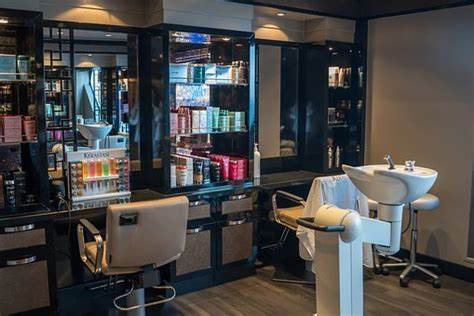
When it comes to finding the right lighting, the type of location plays a big role in the best applications. A hair salon is a genuinely unusual space to light: your clients are there to change how they look, so every styling station is effectively a showroom for the work being done under your fixtures. Get the specs wrong and the color a stylist mixes under your lights will not match what the client sees in the parking lot. Here is what actually matters when you are specifying salon lighting.
Color Rendering Index
CRI matters more in a salon than in almost any other commercial space, because hair color is being mixed, applied, and evaluated under your fixtures. A low CRI source shifts reds and oranges in particular, which is exactly the range that causes callbacks.
For styling stations and any area where color is being applied or assessed, specify CRI 90 or above. You will see 80+ quoted as a general commercial minimum, and that is fine for a back office or a stock room, but it is not enough for color-critical work. If the space also does nails, that task area wants 95+ — technicians are judging fine color detail at close range.
Color Temperature
Color temperature is a separate spec from CRI and the two get confused constantly. CRI describes how faithfully a light source renders colors. Color temperature describes where the light itself sits on the warm-to-cool scale, in Kelvin.
Salons do best with color temperature zoned by area rather than one setting throughout:
- Styling stations: 3500K to 4000K. Neutral enough for accurate color work without reading cold or clinical. Going warmer than this puts a yellow cast on hair color; going much cooler is harsh and unflattering.
- Reception and waiting areas: 2700K to 3000K. Warmer light here reads as relaxed and welcoming, and nobody is evaluating color in the waiting room.
Fixtures with selectable CCT are worth raising with the owner. They let the space be tuned after opening without swapping hardware, which is useful when a stylist decides the stations feel too cool a month in.
Heat at the Chair
This one gets overlooked because it does not appear on a photometric report. A client sits under a styling light for an hour or more, sometimes with heat already being applied to their hair. Fixtures that convert a large share of their energy into heat instead of light make that experience worse for the client and for the stylist standing beside them all day.
Incandescent and halogen are the offenders. Both run hot enough to be noticeable at close range over a long appointment. LED runs substantially cooler at the same light output, which is one of the less-discussed reasons it suits this application.
Mirror Glare and Shadows
Every styling station has a mirror, and a mirror will take whatever you aim at it and put it straight into someone's eyes. This is the most common practical mistake in salon lighting and it is a placement problem, not a fixture problem.
- Aim directional and track fixtures so the beam lands on the client and the work, not on the mirror face.
- Use vanity and mirror bar lights at the station itself for even, shadow-free light on the face — this is what actually kills the under-eye and under-chin shadows that overhead light alone creates.
- Layer uplight with downlight rather than relying on ceiling fixtures for everything. Downlight alone casts hard shadows; a mix fills them in and makes the room feel more open.
- Mix fixture types on purpose. A salon lit entirely by one product looks flat no matter how good that product is.
Fixture Types by Zone
The fixtures used in salons are diverse, and the point is not to pick one but to combine them into layers. A workable starting scheme:
- General ambient: troffers or recessed downlights spaced across the floor for baseline coverage.
- Styling stations: vanity or mirror bar lights for face-level light, supported by recessed cans overhead.
- Reception and retail: wall sconces to layer warmth in, plus track or accent light on product displays.
- Shampoo area: this is a wet zone. Fixtures directly above the bowls need a wet-location rating, and adjacent areas need damp-rated at minimum. It comes up on inspection, so confirm it on the spec sheet before rough-in.
Energy Efficiency and Operating Hours
Salons run long days to fit client schedules, often twelve hours or more, six or seven days a week. At that duty cycle wattage compounds quickly, and the gap between an LED scheme and anything else shows up on the utility bill within the first quarter.
LED delivers higher lumen output per watt, lasts longer, and needs less maintenance than comparable sources — which matters when replacing a lamp means working over a client chair during business hours. DLC-listed fixtures also often qualify for utility rebates, and those programs generally require pre-approval before installation starts, so it is worth asking early rather than after the fixtures are up.
Planning a Salon Lighting Project?
Our lighting specialists can help you match fixtures to each zone, confirm CRI and wet-location specs, and check the layout before you order. Free lighting layout assistance is available on commercial projects.
SHOP SALON LIGHTING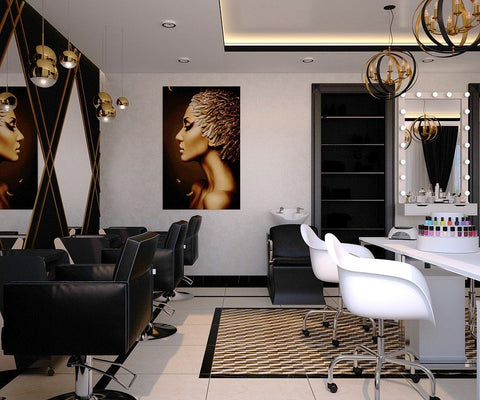
Nail Salon Lighting
From color rendering to the matter of heat production, we break down the best bets for nail salon lighting. Find out more right here!
Read Article
Makeup Application Lighting
Creating the right lighting solutions for any space requires some careful planning. When it comes to which lighting is best for makeup application, there are a few considerations to keep in mind fo...
Read Article

