 High Bay LED Lighting
 Industrial Low Bay Lighting
 Industrial Strip Lights
 Vapor Tight Lighting
 LED Shop Lights
 LED Ready Fixtures
 Hazardous Area / Explosion Proof Lighting
 Loading Dock Lights
 Construction / Portable Lighting
 High Temperature LED Lights
 Industrial Ceiling Fans
 LED Work Lights
 Networked Controlled Lighting
 American Made Industrial Lighting
 Clearance
 Troffer Lights
 LED Flat Panel Lights
 Drop Ceiling Lights
 LED Ready Troffers
 Suspended LED Lights
 LED Cylinder Lights
 Stairway & Corridor Lighting
 Hospital Bed Lights
 Wrap Lighting Fixtures
 Gooseneck and Barn Lights
 Commercial Sign Lights
 LED Track Lighting Fixtures & Systems
 Recessed Lighting
 Wafer Lighting
 RGB LED Lights
 Exit / Emergency
 Refrigeration Lighting
 Grow Lights
 UV Disinfecting Lights & Air Purifier Fixtures
 American Made Commercial Lighting
 LED Flood Lights
 Outdoor Wall Lights
 LED Area Lights
 Parking Lot Lights & Poles
 Outdoor Post Top Lights
 LED Stadium Lighting
 Canopy Lights
 Security & Motion Sensor Lights
 LED Bollard Lights
 Outdoor Barn Lights
 Solar Powered LED Lighting
 Dusk to Dawn Lights
 Landscape Lighting
 Outdoor String Lights
 Coastal Wildlife Lighting
 Outdoor House Lights
 American Made Outdoor Lighting
 Architectural Linear Lights
 Architectural Grid Mount Lights
 Architectural Round Pendant Lights
 Architectural Curved LED Linear Lights
 Architectural Square Linear Lights
 Architectural X-Shaped Linear Lights
 Architectural LED Wall Packs
 Ceiling Fans
 Ceiling Lights
 Chandelier Lights
 Pendant Lighting
 Island Lights
 Under Cabinet Lighting
 Vanity Lights
 Wall Sconces
 LED Tape Lights
 LED Mirrors
 LED Light Bulbs
 LED Tube Lights
 LED Corn Lights
 Vintage LED Bulbs
 Decorative LED Bulbs
 Fluorescent Light Bulbs
 Metal Halide Lamps
 LED Magnetic Strip Retrofit Kits
 LED Strip Light Retrofit Kits
 High Bay LED Retrofit Kits
 LED Troffer Retrofit Kits
 LED Wall Pack Retrofit
 LED Street Light Retrofit Kits
 Recessed Lighting LED Retrofit Kits
 WareSense Blue - Bluetooth Control System
 Ballasts & Drivers
 Emergency Ballast For LED & Fluorescent Lights
 Electrical Supplies & Mounting Kits
 Electrical Tools
 Switches & Receptacles
 Electrical Power Cords
 Sensors and Timers
 Smart Home Automation
 High Bay Occupancy Sensors
 Electric Vehicle Chargers
 Hand Dryers
 LED Shop Lights
 Garage LED Lighting
 Gym Lighting
 Factory Lights
 Restaurant Lights
 Office Lights
 Classroom Lights
 Church Lights
 Warehouse Lights
 Hospital Lights
 Walkway Lights
 Parking Lot Lights
 Exterior Building Lights
 Sports Lighting
 Airport Lights
 NSF Rated Lights
 TAA LED Lighting
 Corridor Lights
 Barn Lighting
 Multi-Family Lighting Solutions






Clocks go back on the first Sunday in November, and for most commercial properties that single hour is the difference between closing up in daylight and closing up in the dark. Staff leave after sunset. Customers arrive after sunset. The parking lot, the walkways and the building entrance all have to work for several more hours a day than they did in August.
The properties that handle this well are the ones that sorted it out in September. Fixtures need specifying, lead times need allowing for, and an electrician has to be booked. This guide covers what to light outside, how much light each area needs, which control method suits which application, and what changes indoors once daylight stops doing half the work.
Why Earlier Sunsets Change the Requirement
The change is bigger than it feels. In the northern half of the country, sunset moves from around 8:30pm in late June to a little after 4:30pm in December — and the hour lost when Standard Time returns lands right on the evening commute. A retail lot that saw no dark trading in summer may be operating in full darkness for its busiest hours by Thanksgiving.
Three things follow from that:
- Run hours roughly double. Fixtures that ran four hours a night in summer may run ten or more in December, which is what makes efficiency and service life worth paying for.
- Gaps become visible. A dark corner nobody noticed in July becomes the reason someone parks elsewhere in December.
- Weather arrives at the same time. Rain, snow and salt spray hit exactly when the fixtures are working hardest, so wet-location ratings and sealed housings matter.
How Much Light Does Each Area Need?
Before choosing fixtures, it helps to know roughly what you are aiming for. Illuminance is measured in foot-candles, and commonly used commercial targets look something like this:
- Parking lots, general: around 0.5 to 2 foot-candles average, depending on whether the site is low or high activity.
- Parking lots, security-sensitive: higher, often 2 to 5 foot-candles, particularly near entrances and cash-handling areas.
- Walkways and paths: roughly 1 to 2 foot-candles, with attention to uniformity rather than raw output.
- Building entrances: around 5 foot-candles, higher than the surrounding lot so the door reads as the destination.
- Covered canopies and fuel islands: considerably higher, often 10 to 20 foot-candles, because the eye is adapting from a brightly lit area to a dark one.
Treat those as starting points rather than specifications. IES guidance, local ordinances and any lighting requirements attached to your zoning or insurance take precedence, and uniformity — how evenly light is distributed — often matters more for perceived safety than the average figure does. Our team offers free lighting layout and photometric services if you want the numbers modeled for your actual site.
LED Wall Pack Lights

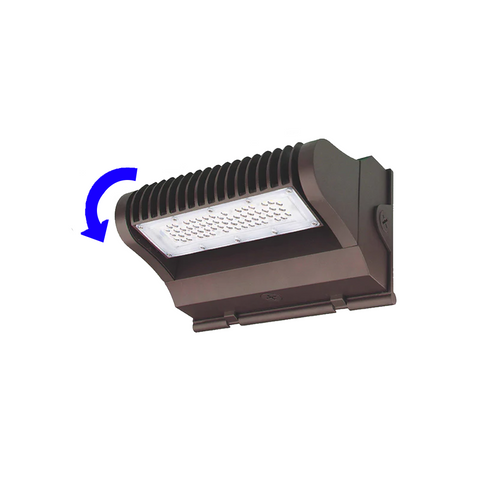
Wall packs are the workhorse of building perimeter lighting: mounted to the wall, throwing light down and outward across the immediate area. Die-cast aluminum housings and wet-location ratings let them run through winter without trouble, and they suit exactly the long-duration operation that shorter days demand.
Two decisions matter when specifying them. Distribution determines whether light goes mostly downward or spreads outward — full cutoff and semi-cutoff optics keep light on your property and out of neighboring windows, which is increasingly a code requirement rather than a courtesy. Output should be matched to mounting height: a fixture that works at 12 feet will leave dark patches at 20.
If you are replacing metal halide, expect to need far less wattage than the fixture you are removing. An LED wall pack typically delivers comparable light at roughly a quarter to a third of the wattage, which is where the run-hour savings come from once nights get long.
Parking Lot and Flood Lights

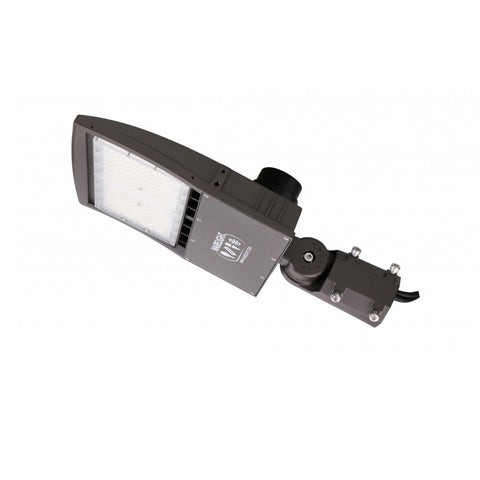
These are two different tools that often get discussed together. Pole-mounted area lights cover open parking with controlled, even distribution and are what you want for the lot itself. Flood lights throw a concentrated beam at a target — a building face, a loading area, a sign, a yard — and are the wrong choice for general parking coverage because they create bright pools and dark gaps.
For parking areas, distribution type is the specification that matters most. Type III suits the perimeter of a lot, Type V throws in all directions from a central pole, and forward-throw optics suit a pole against a building wall. Getting this right is what produces even coverage rather than a lot with bright circles and dark lanes between them.
Uniformity is worth more than brightness here. A lot lit evenly at 1 foot-candle feels safer, and is easier for cameras to work in, than one averaging 2 foot-candles with deep shadows between poles.
Where a pole sits near a property line, a residential boundary or a roadway, add a shield. Most area lights offer side and front or back shields as an ordering option, and they physically block light from leaving the fixture in that direction. They are chosen at the point of order rather than added later, so work out where your boundaries are before you buy.
Dusk to Dawn Lighting

Dusk-to-dawn fixtures carry an integrated photocell that switches the light on as ambient daylight drops and off again at sunrise. They do not spring forward or fall back, and they need no reprogramming as sunset moves through the season — which is precisely the problem they solve. A timer set in September is wrong by November.
They are the low-maintenance choice for perimeter and security lighting that simply needs to be on whenever it is dark. The trade-off is that they run all night at full output unless paired with dimming or motion control.
Photocell, Timer or Motion Sensor?
The control method matters as much as the fixture, and it is the decision most often made by default. Each suits a different situation:
- Photocell (dusk to dawn): switches on darkness. Self-adjusting through the seasons, no programming, no drift. Best for security and perimeter lighting that must be on all night.
- Timer or astronomical time clock: switches on a schedule. Useful when you want lights off after closing rather than all night, but a basic timer needs resetting as sunset shifts. An astronomical clock tracks sunrise and sunset by date and location and avoids that.
- Motion sensor: switches on occupancy. Best in low-traffic areas — rear entrances, service yards, employee lots after hours — where full-time light is not needed. Often paired with a photocell so it only triggers after dark.
- Bi-level or dimming control: holds a low background level and steps to full output on motion. This is the efficient middle ground for parking areas that need to stay visible but not fully lit at 3am, and it is increasingly what energy codes expect.
Mini LED Wall Packs

Mini wall packs deliver useful output from a much smaller housing, which suits doorways, service entrances, stairwells, pathways and signage — anywhere a full-size wall pack would be overpowered or physically out of scale. They fill the gaps between larger fixtures, and gaps are exactly what get noticed once it is dark at 5pm.
Bollards, Pathway and Step Lighting
Walkways are the part of a property that changes most when the clocks go back. A path people crossed in daylight all summer becomes a route they cross in the dark twice a day, and the hazards on it — a curb, a single step, a change in surface, standing water that will be ice by January — stop being visible.
Bollard lights are the standard answer for walkways, plazas, entry paths and the edges of parking areas. Mounted at roughly waist height, they light the walking surface directly rather than washing it from a pole overhead, which puts light exactly where a pedestrian needs it and keeps glare out of their eyes. They also mark the edge of a path visually, so the route is legible before you are standing on it.
Step lights handle the specific problem bollards cannot: level changes. Recessed into a riser or an adjacent wall, they wash the tread of each step so a change in height reads clearly from above.
Two points when specifying. Aim for uniformity rather than output — evenly spaced fixtures at modest brightness beat a few bright ones with dark stretches between, because the eye adapts to the brightest thing it can see and everything else goes darker by comparison. And confirm the wet-location rating: bollards sit at ground level where they meet sprinklers, snow, road salt and landscaping equipment.
Gooseneck and Sign Lighting
Here is the thing most properties overlook until December: once it is dark at 4:30pm, an unlit sign is an invisible sign. Every hour of trading after sunset is an hour your building is not identifying itself to passing traffic — and in November and December that can be most of the trading day.
Gooseneck lights mount to the wall on a curved arm that carries a shaded head out over the surface below, aiming light down onto a sign face, a facade, an awning or an entrance. The shade is the point: it keeps the light on the target rather than spilling into the street or up into the sky, which is what makes them the standard choice for exterior signage in jurisdictions with dark-sky or light-trespass rules.
They also do work no other fixture on this list does. A gooseneck over an entrance identifies the door from across a parking lot. A row along a facade gives a flat building face some depth after dark. Barn-style versions cover the same ground where the look suits the property.
Two things to check. Confirm the arm length and projection suit the sign or surface you are lighting, since a short arm on a deep sign lights the top and leaves the bottom dark. And if the sign is internally illuminated already, you may need less than you think — the surrounding wall may be the part that actually needs light.
Canopy Lights

Canopy lights handle covered outdoor structures: fuel islands, drive-throughs, bus shelters, parking garages and covered entries. These spaces need more light than the areas around them, not less. A driver pulling under a canopy at night is moving from darkness into a covered space, and if the canopy is dimly lit it reads as a tunnel.
For parking garages specifically, look for fixtures rated for the environment — vibration, exhaust, washdown — and consider bi-level motion control, which is standard practice in garages that run 24 hours.
Indoor Lighting Gets Harder Too
The outdoor problem is obvious — it is dark when people arrive and dark when they leave. The indoor problem is quieter. Spaces that borrowed daylight all summer stop borrowing it, and nobody notices because the lights were already on.
Look at what changes. Any area with skylights, clerestory windows or a glazed wall was running on a mix of daylight and electric light through August. By December that mix is gone and the fixtures are carrying the whole load. If the electric lighting was specified to supplement daylight rather than replace it, the space is now underlit for half the working day — and because it happened gradually, it reads as normal.
Offices and Administrative Areas
General office work is commonly specified around 30 to 50 foot-candles at the desk, with higher levels where detailed work happens. Flat panels are the usual fit for a grid ceiling, and suspended linear works where the ceiling is open or the look matters. Both are available with selectable wattage and CCT, which is useful when you are not certain what a space needs until it is installed. 4000K suits most office environments; 5000K reads brighter and colder and suits task areas more than desks.
Warehouse and Production Floors
Aisle and general storage lighting is typically specified around 10 to 20 foot-candles, rising substantially where assembly, inspection or color-critical work happens. Linear high bay suits racking, where the light needs to reach down between aisles rather than spread out. UFO high bay suits open floor. Both are direct replacements for metal halide at roughly a quarter to a third of the wattage — the same arithmetic as outdoors, and it matters more indoors because the fixtures were already running all shift.
Plan the Facility, Not the Fixture
The most expensive way to light a building is one failure at a time. Replacing fixtures only as they die produces a floor with four generations of technology on it, mismatched color temperatures, and no coherent layout. Looking at a whole area at once — the office block, the production floor, the loading bay — gets you a better result for less money, and it is the only way to specify controls sensibly.
A Walkthrough Worth Doing in September
The most useful thing you can do costs nothing. Once it is properly dark, walk the property the way a customer or employee would — from the far corner of the lot to the front door, and from the staff exit to wherever people park.
- Where are the dark patches between poles?
- Is the entrance clearly brighter than the lot, so it reads as the way in?
- Can you read the sign from the road, at the speed traffic actually passes?
- Are any fixtures out, dim, or gone yellow — a sign of an aging HID lamp near end of life?
- Is light spilling onto a neighboring property or into traffic?
- Do the security cameras have enough light, and enough uniformity, to produce a usable image?
- Are walkways and steps lit well enough to see a change in level?
- Inside, are the areas that sit under skylights or beside glazing still bright enough once it is dark outside?
Do that in September and there is time to order, take delivery and get an electrician booked before the clocks change. Do it in December and you are competing for the same electrician as everyone else who left it late.
Get a Head Start on Shorter Days
Outside: wall packs cover building perimeters, mini wall packs handle doorways and pathways, pole-mounted area lights light parking evenly, flood lights target specific surfaces, bollards and step lights keep walkways and level changes visible, gooseneck fixtures keep your sign readable after dark, dusk-to-dawn fixtures adjust themselves as sunset moves, and canopy lights keep covered spaces from reading as dark voids. Inside: flat panels and suspended linear cover offices, and linear and UFO high bay cover production floors and racking.
Not sure where to start? Our lighting experts offer free lighting design and layout services to help you build the right plan for your property, with no obligation.
FAQs About Commercial Lighting for Winter
When should I upgrade outdoor lighting before winter?
Early autumn, before the clocks change on the first Sunday in November. Working back from that date allows time to survey the property after dark, specify fixtures, allow for shipping, and book an electrician — who will be considerably busier once everyone else notices their lot is dark. Starting in September is comfortable; starting in November is not.
What is the difference between a flood light and a parking lot light?
A flood light produces a concentrated beam aimed at a specific target — a building facade, a sign, a loading dock, a yard. A parking lot or area light is pole-mounted and engineered for even distribution across an open surface. Using flood lights to cover a parking lot generally produces bright pools with dark gaps between them, which is worse for both perceived safety and camera coverage than lower, more uniform light.
How many foot-candles does a commercial parking lot need?
Commonly used targets run from roughly 0.5 to 2 foot-candles average for general parking, rising to 2 to 5 for security-sensitive areas and around 5 at building entrances. Uniformity matters as much as the average: an evenly lit lot at a lower level feels safer and works better for cameras than a brighter one with deep shadows. Local ordinances, IES guidance and insurance requirements should be confirmed for your specific site.
How many foot-candles does an office need?
Around 30 to 50 foot-candles at the work surface is the range commonly specified for general office work, rising where detailed or color-critical tasks happen. IES guidance and any client or tenant requirement take precedence. Uniformity and glare control matter as much as the number on a meter — a space lit evenly at 35 foot-candles is more comfortable to work in than one averaging 50 with bright patches and deep shadows.
Do I need more indoor lighting in winter?
Not necessarily more fixtures, but any space that relied on daylight is now running entirely on electric light. Areas with skylights, clerestory windows or large glazing were getting a contribution from daylight through summer that disappears by December. If the electric lighting was specified to supplement daylight rather than replace it, those spaces are underlit for part of the working day. The reliable way to find out is to measure the area after dark rather than assume it is fine because it was fine in July.
What is the best way to light an exterior business sign?
Gooseneck fixtures are the usual answer for a non-illuminated sign. Mounted above the sign on a curved arm, the shaded head aims light down onto the face rather than out into the street or up into the sky, which keeps the sign readable and helps with dark-sky and light-trespass requirements. Match the arm length and projection to the depth of the sign so the bottom is lit as well as the top, and space multiple fixtures evenly across a wide sign. Where the sign is internally illuminated, the surrounding wall or entrance is often what actually needs the light.
How far apart should bollard lights be spaced on a walkway?
Spacing depends on the fixture's output and distribution, but a common approach is to space bollards at roughly three to four times their mounting height, then check the result for dark gaps between them. Uniformity is the goal rather than brightness — evenly spaced fixtures at a modest level make a path easier to read than a few bright ones with dark stretches in between, because the eye adapts to the brightest point in view. A photometric layout is the reliable way to confirm spacing before ordering.
Do dusk to dawn lights need adjusting when the clocks change?
No. Dusk-to-dawn fixtures use a photocell that responds to ambient light levels rather than to a clock, so they switch on when it gets dark regardless of the date or the time change. That is their main advantage over a basic timer, which has to be reset as sunset drifts through the season. An astronomical time clock is the alternative if you want scheduled control that tracks sunset automatically.
Should outdoor lights be on all night or on motion sensors?
It depends on the area. Customer-facing parking, entrances and walkways generally stay lit whenever the property is occupied or accessible. Low-traffic areas such as service yards, rear entrances and staff lots after hours are good candidates for motion control. Many sites use bi-level control as a middle ground: a reduced background level all night, stepping to full output on motion. That keeps the site visible for cameras and passers-by while cutting run-hour energy.
What LED wattage replaces a 400W metal halide fixture?
As a rough guide, LED delivers comparable light at roughly a quarter to a third of the wattage, so a 400W metal halide is often replaced by an LED fixture in the 100W to 150W range. Compare delivered lumens rather than watts, and factor in that metal halide loses a substantial share of its output over its life — an aging 400W lamp may be producing far less than its rated figure, so the fixture you are replacing may be dimmer than the spec sheet suggests.
How do I stop outdoor lighting spilling onto neighboring property?
Start with the optics. Full cutoff and semi-cutoff fixtures direct light downward rather than sideways and upward, and the fixture's BUG rating (Backlight, Uplight, Glare) describes how much escapes in each direction if your jurisdiction references it.
Then add a shield. This is what shields are for, and they are the most direct fix available. Most commercial area and parking lot lights offer them as an ordering option: a side shield blocks light from leaving the sides of the fixture, and a front or back shield stops it throwing past the target or backward behind the pole. Where a pole sits near a property line, a residential boundary or a roadway, a shield is often the difference between a compliant install and a complaint from the neighbors. They cost very little, but they are selected when the fixture is ordered rather than retrofitted afterward, so identify your boundaries before you buy.
Mounting height and aiming angle affect spill as well — a fixture aimed even slightly upward throws light a long way. Many municipalities now have dark-sky or light-trespass ordinances, so confirm local requirements before ordering rather than after installation.


