High Bay LED Lighting
 Industrial Low Bay Lighting
 Industrial Strip Lights
 Vapor Tight Lighting
 LED Shop Lights
 LED Ready Fixtures
 Hazardous Area / Explosion Proof Lighting
 Loading Dock Lights
 Construction / Portable Lighting
 High Temperature LED Lights
 Industrial Ceiling Fans
 LED Work Lights
 Networked Controlled Lighting
 American Made Industrial Lighting
 Clearance
 Troffer Lights
 LED Flat Panel Lights
 Drop Ceiling Lights
 LED Ready Troffers
 Suspended LED Lights
 LED Cylinder Lights
 Stairway & Corridor Lighting
 Hospital Bed Lights
 Wrap Lighting Fixtures
 Gooseneck and Barn Lights
 Commercial Sign Lights
 LED Track Lighting Fixtures & Systems
 Recessed Lighting
 Wafer Lighting
 RGB LED Lights
 Exit / Emergency
 Refrigeration Lighting
 Grow Lights
 UV Disinfecting Lights & Air Purifier Fixtures
 American Made Commercial Lighting
 LED Flood Lights
 Outdoor Wall Lights
 LED Area Lights
 Parking Lot Lights & Poles
 Outdoor Post Top Lights
 LED Stadium Lighting
 Canopy Lights
 Security & Motion Sensor Lights
 LED Bollard Lights
 Outdoor Barn Lights
 Solar Powered LED Lighting
 Dusk to Dawn Lights
 Landscape Lighting
 Outdoor String Lights
 Coastal Wildlife Lighting
 Outdoor House Lights
 American Made Outdoor Lighting
 Architectural Linear Lights
 Architectural Grid Mount Lights
 Architectural Round Pendant Lights
 Architectural Curved LED Linear Lights
 Architectural Square Linear Lights
 Architectural X-Shaped Linear Lights
 Architectural LED Wall Packs
 Ceiling Fans
 Ceiling Lights
 Chandelier Lights
 Pendant Lighting
 Island Lights
 Under Cabinet Lighting
 Vanity Lights
 Wall Sconces
 LED Tape Lights
 LED Mirrors
 LED Light Bulbs
 LED Tube Lights
 LED Corn Lights
 Vintage LED Bulbs
 Decorative LED Bulbs
 Fluorescent Light Bulbs
 Metal Halide Lamps
 LED Magnetic Strip Retrofit Kits
 LED Strip Light Retrofit Kits
 High Bay LED Retrofit Kits
 LED Troffer Retrofit Kits
 LED Wall Pack Retrofit
 LED Street Light Retrofit Kits
 Recessed Lighting LED Retrofit Kits
 WareSense Blue - Bluetooth Control System
 Ballasts & Drivers
 Emergency Ballast For LED & Fluorescent Lights
 Electrical Supplies & Mounting Kits
 Electrical Tools
 Switches & Receptacles
 Electrical Power Cords
 Sensors and Timers
 Smart Home Automation
 High Bay Occupancy Sensors
 Electric Vehicle Chargers
 Hand Dryers
 LED Shop Lights
 Garage LED Lighting
 Gym Lighting
 Factory Lights
 Restaurant Lights
 Office Lights
 Classroom Lights
 Church Lights
 Warehouse Lights
 Hospital Lights
 Walkway Lights
 Parking Lot Lights
 Exterior Building Lights
 Sports Lighting
 Airport Lights
 NSF Rated Lights
 TAA LED Lighting
 Corridor Lights
 Barn Lighting
 Multi-Family Lighting Solutions



How Light Switches Are Rated
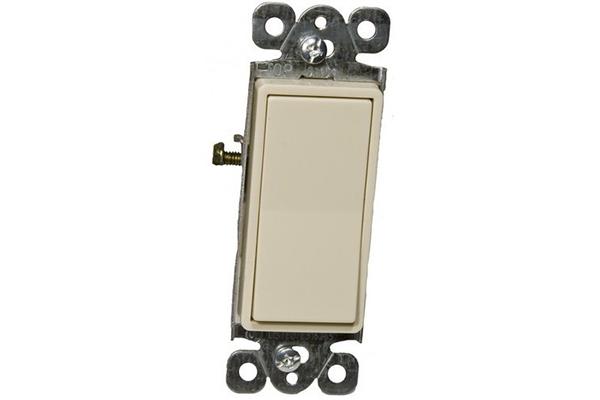
Switch ratings are the part of a lighting spec that gets skipped until something fails. On a commercial job the switch has to match the voltage, the current, the load type, and the environment. Get any one of those wrong and it shows up as a nuisance trip, a welded contact, a buzzing device, or a failed inspection.
Here is what the ratings stamped on a light switch actually mean, and what to confirm before you order.
Amperage and Voltage
Every general-use switch carries a current rating and a voltage rating, usually stamped on the metal yoke or molded into the side of the body. Both have to cover the circuit it is going on.
| Rating | Typical values | Where you see it | Watch for |
|---|---|---|---|
| Current | 15A, 20A | General lighting branch circuits | Size above the connected load, not level with it |
| Voltage | 120V, 277V, 120-277V | 277V is the commercial standard | A 120V-only device will not survive a 277V circuit |
| Horsepower | 1/2 HP, 1 HP, 2 HP | Fan controls and motor loads | Lighting-only switches often carry no HP rating at all |
| Current type | AC only, or AC/DC | Most wall switches are AC only | AC-only devices must not be used on DC circuits |
277V is the rating that catches people moving from residential to commercial work. Commercial buildings are commonly fed 480/277V three-phase wye, which puts 277V on the lighting branch circuits. A switch pulled off the shelf for a house is rated 120V and has no business on that circuit. Dual-rated 120-277V devices cover both and are the safe default on mixed jobs.
AC and DC Ratings Are Not Interchangeable
This is the rating most often misunderstood, and the direction of the rule matters.
Alternating current crosses zero volts 120 times per second on a 60 Hz system. When switch contacts separate, that zero crossing extinguishes the arc almost immediately. Direct current has no zero crossing. The arc has nothing to interrupt it, so it sustains across the opening contacts, which erodes them and can weld them closed.
The practical consequence: a switch listed for AC only must not be put on a DC circuit, regardless of how the amperage compares. A device rated for DC will carry a separate DC rating, and that rating is normally lower than its AC rating for the same device. Never infer one from the other.
For most commercial lighting this is a non-issue, since line-voltage lighting is AC and standard general-use snap switches are listed accordingly. It becomes relevant on low-voltage DC systems, DC microgrids, solar-fed lighting, and 24V or 48V DC fixtures, where a general-purpose wall switch is the wrong device.
Load Type and LED Inrush
The amperage rating assumes a resistive load. LED drivers are not resistive. Each driver draws a brief inrush current at switch-on that can run many times its steady-state draw, and that inrush is cumulative across every driver on the switch.
A bank of LED fixtures that sits comfortably inside a 20A rating in normal operation can exceed the contact rating for a few milliseconds at every switch-on. Over enough cycles that pits the contacts. If you are switching a large fixture count from one device, check the inrush figure on the driver spec sheet, multiply it out, and consider a relay or a contactor rather than switching the load directly.
Continuous loads deserve the same caution. Where lighting runs for three hours or more at a stretch, the switch should be sized with headroom above the connected load rather than matched to it.
UL Listing and Device Grade
A UL listing means the device has been tested to a recognized safety standard for its category. Line-voltage wall switches are listed as general-use snap switches. On commercial work this is not optional, and an unlisted device will not pass inspection.
Beyond the listing, devices are sold in grades, and the grade is what determines how long the switch lasts in service:
- Residential grade. Lowest cost, 15A, built for light duty and infrequent operation. Fine in a house, short-lived in a building where the lights are cycled many times a day.
- Spec grade. Heavier internal construction, better contact material, longer mechanical life. The normal baseline for commercial work.
- Commercial and industrial grade. Highest cycle life and impact resistance, often with a back-and-side wire capability. Worth the cost in schools, warehouses, healthcare, and anywhere a failure means a service call.
Environment matters too. Wet and damp locations need a device and cover plate rated for it, and cold or high-vibration spaces have their own requirements.
What to Confirm Before You Order
- Circuit voltage, and whether the device is 120V, 277V, or dual-rated 120-277V.
- Connected load in amps, with headroom rather than an exact match.
- Whether the load is continuous.
- AC or DC, and never substitute one listing for the other.
- Driver inrush multiplied by fixture count if you are switching a large bank.
- Horsepower rating if any part of the load is a motor or a fan.
- Grade appropriate to the cycle count the space will see.
- Location rating for wet, damp, or hazardous areas.
Shop by device type across our commercial electrical switches, including single pole switches, three-way switches, four-way switches, and commercial dimmer switches.
If the ratings on a spec are unclear, talk to our lighting specialists before you order.