High Bay LED Lighting
 Industrial Low Bay Lighting
 Industrial Strip Lights
 Vapor Tight Lighting
 LED Shop Lights
 LED Ready Fixtures
 Hazardous Area / Explosion Proof Lighting
 Loading Dock Lights
 Construction / Portable Lighting
 High Temperature LED Lights
 Industrial Ceiling Fans
 LED Work Lights
 Networked Controlled Lighting
 American Made Industrial Lighting
 Clearance
 Troffer Lights
 LED Flat Panel Lights
 Drop Ceiling Lights
 LED Ready Troffers
 Suspended LED Lights
 LED Cylinder Lights
 Stairway & Corridor Lighting
 Hospital Bed Lights
 Wrap Lighting Fixtures
 Gooseneck and Barn Lights
 Commercial Sign Lights
 LED Track Lighting Fixtures & Systems
 Recessed Lighting
 Wafer Lighting
 RGB LED Lights
 Exit / Emergency
 Refrigeration Lighting
 Grow Lights
 UV Disinfecting Lights & Air Purifier Fixtures
 American Made Commercial Lighting
 LED Flood Lights
 Outdoor Wall Lights
 LED Area Lights
 Parking Lot Lights & Poles
 Outdoor Post Top Lights
 LED Stadium Lighting
 Canopy Lights
 Security & Motion Sensor Lights
 LED Bollard Lights
 Outdoor Barn Lights
 Solar Powered LED Lighting
 Dusk to Dawn Lights
 Landscape Lighting
 Outdoor String Lights
 Coastal Wildlife Lighting
 Outdoor House Lights
 American Made Outdoor Lighting
 Architectural Linear Lights
 Architectural Grid Mount Lights
 Architectural Round Pendant Lights
 Architectural Curved LED Linear Lights
 Architectural Square Linear Lights
 Architectural X-Shaped Linear Lights
 Architectural LED Wall Packs
 Ceiling Fans
 Ceiling Lights
 Chandelier Lights
 Pendant Lighting
 Island Lights
 Under Cabinet Lighting
 Vanity Lights
 Wall Sconces
 LED Tape Lights
 LED Mirrors
 LED Light Bulbs
 LED Tube Lights
 LED Corn Lights
 Vintage LED Bulbs
 Decorative LED Bulbs
 Fluorescent Light Bulbs
 Metal Halide Lamps
 LED Magnetic Strip Retrofit Kits
 LED Strip Light Retrofit Kits
 High Bay LED Retrofit Kits
 LED Troffer Retrofit Kits
 LED Wall Pack Retrofit
 LED Street Light Retrofit Kits
 Recessed Lighting LED Retrofit Kits
 WareSense Blue - Bluetooth Control System
 Ballasts & Drivers
 Emergency Ballast For LED & Fluorescent Lights
 Electrical Supplies & Mounting Kits
 Electrical Tools
 Switches & Receptacles
 Electrical Power Cords
 Sensors and Timers
 Smart Home Automation
 High Bay Occupancy Sensors
 Electric Vehicle Chargers
 Hand Dryers
 LED Shop Lights
 Garage LED Lighting
 Gym Lighting
 Factory Lights
 Restaurant Lights
 Office Lights
 Classroom Lights
 Church Lights
 Warehouse Lights
 Hospital Lights
 Walkway Lights
 Parking Lot Lights
 Exterior Building Lights
 Sports Lighting
 Airport Lights
 NSF Rated Lights
 TAA LED Lighting
 Corridor Lights
 Barn Lighting
 Multi-Family Lighting Solutions




Translation missing: en.collections.filters.title
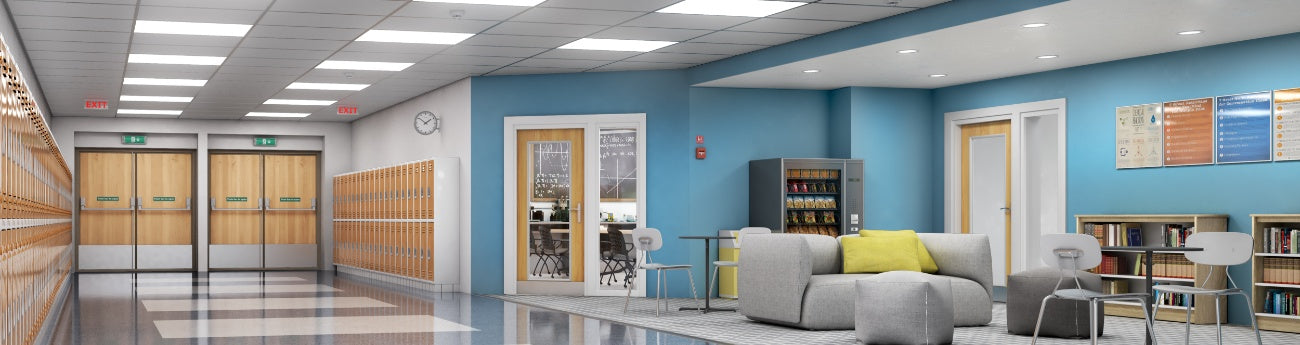
School and classroom LED lighting creates bright, comfortable, energy-efficient learning environments — from individual classrooms and labs to libraries, corridors, gyms, and cafeterias across schools and universities. The right fixtures improve visibility and focus while lowering energy and maintenance costs, and features like selectable color temperature and dimming let teachers tune light to different activities. Below are the fixture types used most in classrooms and schools, how to choose them, and answers to common questions.


423 products

Sale


ITEM: 4976BLE-15
Regular price$139.00
$102.96
Sale

ITEM: 4977BLE-15
Regular price$191.65
$141.96

Classroom Lighting Applications
Classroom lighting sets the tone for how well students see their work and how long they can stay focused on it. A school building is rarely just classrooms, though, so the fixtures here also cover the labs, libraries, gyms, and hallways that make up the rest of the campus. Most of what you will use are recessed flat panels and troffers for grid ceilings, plus surface-mount wraparound fixtures and strip lights for rooms without a drop ceiling. Our own WareLight fixtures are built and backed directly by us, and we recommend them for most classroom and campus lighting projects.
Common applications include:
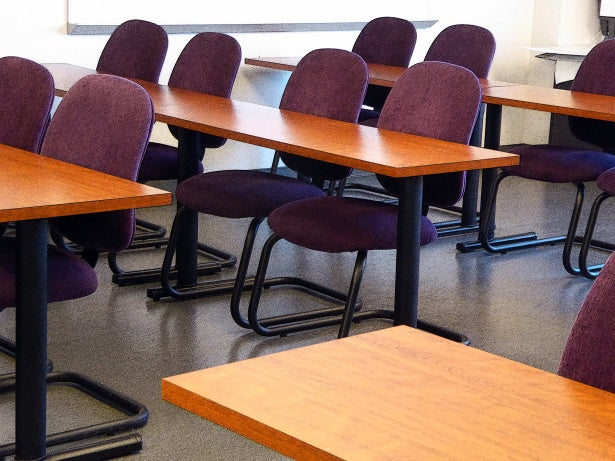
- Standard classrooms and lecture rooms: Effective classroom lighting combines function and comfort to create an engaging learning environment. Tailor lighting intensity to specific activities, use adjustable or selectable-CCT LED fixtures, incorporate dimmable lighting for flexibility, and factor in the room's layout when planning fixture placement.
- Science labs and STEM spaces: Bright, even lighting helps support hands-on instruction and detailed work.
- Libraries and media centers: Comfortable, low-glare illumination creates an ideal environment for reading, studying, and computer use.
- Gyms and multipurpose rooms: High-output fixtures provide uniform lighting for athletic activities, assemblies, and community events.
- Cafeterias and commons: Durable LED fixtures deliver bright, welcoming illumination for dining and gathering spaces.
- Corridors, stairwells, and entryways: Reliable lighting improves visibility and helps students, staff, and visitors move safely throughout the building.
- Administrative offices and workrooms: Even, comfortable lighting supports daily office tasks and administrative work.
- Exit and emergency lighting: Code-required exit signs and emergency fixtures help keep hallways and stairwells safely illuminated during power outages.
- Outdoor school lighting: Parking lots, walkways, courtyards, sports fields, and building entrances benefit from dependable exterior lighting that improves visibility and security after dark.
- LED retrofit projects: Retrofit kits upgrade existing fixtures with energy-efficient, long-lasting LED technology, making them a practical solution for classrooms, offices, parking lots, and other areas with outdated lighting.
Benefits of Upgrading Your Classroom Lighting
Most of these fixtures replace aging fluorescent tubes that flicker, hum, and cost too much to keep running across a whole district. Here is what schools get out of the switch.
Even, Glare-Controlled Light for Desks and Screens
Diffused panels and troffers spread light evenly across the room, so there are no dark corners at the back and no hot spots washing out a desk or a monitor. That even coverage matters more now that most rooms mix printed material with screens and interactive boards.
Cooler Light That Supports Focus
Warm light is relaxing, which is the opposite of what you want during a math lesson. Cooler light in the 4000K to 5000K range reads as clean daylight and helps keep students alert, which is why it has become the default for education spaces. Most fixtures in this collection are offered in that range.
Fixtures for Every Ceiling on Campus
Not every room has a suspended grid. This collection covers recessed panels and troffers for grid ceilings, surface-mount wraparound and strip fixtures for hard or drywall ceilings, and under-cabinet lights for lab benches and workstations, so you can spec one supplier for the whole building.
Lower Operating Cost and Rebate Eligibility
An LED fixture pulls far fewer watts than the fluorescent it replaces, and a large share of this collection carries a DLC or DLC Premium listing. That listing is usually what makes a fixture eligible for a utility rebate. Our rebates and incentives page shows how to find your local program.
Illuminate Your Campus With the Best LED Light Fixtures
If you're lighting a classroom, a wing, or a whole school and want help matching fixtures to each room and ceiling type, the lighting specialists at Warehouse Lighting can work through it with you. Send us your room sizes and ceiling details, and we can put together a layout and a quote.
Contact UsClassroom Lighting FAQs
How many foot-candles does a classroom need?
The IES puts a typical classroom at about 50 foot-candles, measured at desk height. Elementary rooms can sit closer to 30, while lab work, art, and detailed tasks call for around 75. Whiteboards and screens are their own consideration, since you want enough light on the board without throwing reflections back at the class, so plan the layout around what actually happens in each room.
Can we set different color temperatures for different rooms?
Yes. A large share of the fixtures here are CCT-selectable, meaning you pick the color temperature with a switch on the fixture at install, so the same part number can go in at 3500K in a reading room and 5000K in a lab. Keep in mind that is set at installation, not something a teacher changes mid-lesson. If you want light that shifts through the day, that calls for a dedicated tunable-white or RGBW fixture, which the catalog carries in a smaller selection.
How many lumens do I need for a classroom?
Classroom lighting typically aims for about 500 to 1000 lux. For a standard classroom of around 60 square meters, roughly 30,000 to 60,000 lumens is generally advised (1 lux equals 1 lumen per square meter). Actual needs vary with student age, activities, and available natural light — see our guide on how to calculate how many lumens you need.
Does light flicker actually affect students?
Yes, more than people expect. Old fluorescent lighting pulses at a rate the eye does not consciously catch, and that flicker has been tied to eye strain and headaches over a full school day, with a bigger effect on light-sensitive students. Quality LED fixtures run on flicker-free drivers, which removes that problem entirely.
What fixtures work if a classroom does not have a drop-ceiling grid?
Plenty of older schools have hard plaster or drywall ceilings with no grid to drop a panel into. For those rooms, look at surface-mount wraparound fixtures and LED strip lights, which mount flush to the ceiling or hang on chains or cables. They put out the same clean light as a recessed panel without needing a grid to sit in.
What grants are available for school LED lighting?
Schools can access grants to upgrade to energy-efficient LED lighting from federal, state, and local programs and utility companies. Sources include the U.S. Department of Energy's Office of Energy Efficiency & Renewable Energy (EERE) and utility rebate programs, plus resources through the EPA's Energy Star program. Confirm current availability and eligibility with a grant specialist or advisor. Additional resources: University Lighting, LED Lighting and Test-Taking, 9 Tips for School Lighting, and Classroom Lighting Applications.