 High Bay LED Lighting
 Industrial Low Bay Lighting
 Industrial Strip Lights
 Vapor Tight Lighting
 LED Shop Lights
 LED Ready Fixtures
 Hazardous Area / Explosion Proof Lighting
 Loading Dock Lights
 Construction / Portable Lighting
 High Temperature LED Lights
 Industrial Ceiling Fans
 LED Work Lights
 Networked Controlled Lighting
 American Made Industrial Lighting
 Clearance
 Troffer Lights
 LED Flat Panel Lights
 Drop Ceiling Lights
 LED Ready Troffers
 Suspended LED Lights
 LED Cylinder Lights
 Stairway & Corridor Lighting
 Exit / Emergency
 Wrap Lighting Fixtures
 Gooseneck and Barn Lights
 Commercial Sign Lights
 LED Track Lighting Fixtures & Systems
 Recessed Lighting
 Wafer Lighting
 RGB LED Lights
 Hospital Bed Lights
 Refrigeration Lighting
 Grow Lights
 UV Disinfecting Lights & Air Purifier Fixtures
 American Made Commercial Lighting
 LED Flood Lights
 Outdoor Wall Lights
 LED Area Lights
 Parking Lot Lights & Poles
 Outdoor Post Top Lights
 LED Stadium Lighting
 Canopy Lights
 Security & Motion Sensor Lights
 LED Bollard Lights
 Outdoor LED Linear Light Fixtures
 Solar Powered LED Lighting
 Dusk to Dawn Lights
 Landscape Lighting
 Outdoor String Lights
 Coastal Wildlife Lighting
 Outdoor House Lights
 American Made Outdoor Lighting
 Architectural Linear Lights
 Architectural Grid Mount Lights
 Architectural Round Pendant Lights
 Architectural Square Linear Lights
 Architectural X-Shaped Linear Lights
 Architectural LED Wall Packs
 Ceiling Fans
 Ceiling Lights
 Chandelier Lights
 Pendant Lighting
 Island Lights
 Under Cabinet Lighting
 Vanity Lights
 Wall Sconces
 LED Tape Lights
 LED Mirrors
 LED Light Bulbs
 LED Tube Lights
 LED Corn Lights
 Vintage LED Bulbs
 Decorative LED Bulbs
 Fluorescent Light Bulbs
 Metal Halide Lamps
 LED Magnetic Strip Retrofit Kits
 LED Strip Light Retrofit Kits
 High Bay LED Retrofit Kits
 LED Troffer Retrofit Kits
 LED Wall Pack Retrofit
 LED Street Light Retrofit Kits
 Recessed Lighting LED Retrofit Kits
 WareSense Blue - Bluetooth Control System
 Ballasts & Drivers
 Emergency Ballast For LED & Fluorescent Lights
 Electrical Supplies & Mounting Kits
 Electrical Tools
 Switches & Receptacles
 Electrical Power Cords
 Sensors and Timers
 Smart Home Automation
 High Bay Occupancy Sensors
 Electric Vehicle Chargers
 Hand Dryers
 LED Shop Lights
 Office Lights
 Classroom Lights
 Church Lights
 Gym Lighting
 Factory Lights
 Hospital Lights
 Walkway Lights
 Parking Lot Lights
 Exterior Building Lights
 Sports Lighting
 Airport Lights
 Garage LED Lighting
 NSF Rated Lights
 TAA LED Lighting
 Restaurant Lights
 Corridor Lights
 Barn Lighting




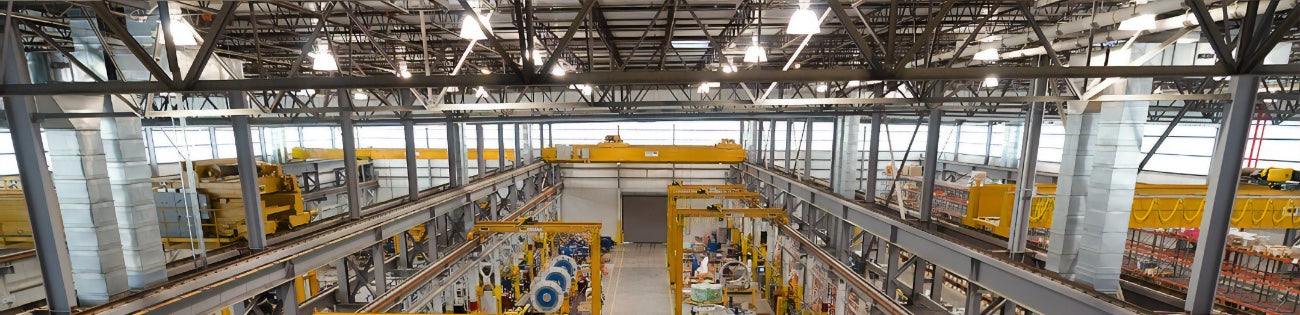
Why Choose LEDs for High Bay Lights?
For years, warehouse, industrial, business and recreational settings have relied on high bay lights in spaces with ceilings ranging from 20 to 45 feet tall to provide sufficient light (no less than 10,000 lumens). High bay LED lights vastly improve upon conventional lighting options— including metal halide, high-pressure sodium and fluorescent bulbs—in many ways.
- Lower Operation & Maintenance Costs. LEDs have a lifespan of more than 50,000 hours, which is four to forty times as long as their conventional counterparts. Not only does this equate to less expense over time on replacement bulbs, but it also means less time (and money) spent on actually changing the bulbs. Replacing high bay lighting bulbs often requires more time and special equipment, like scaffolding, catwalks and hydraulic lifts, to safely reach the light fixtures.
- Outstanding Lighting Performance. One of the biggest draws of LEDs is the exceptional light quality they offer. Light quality is determined by measuring the color rendering index (CRI), correlated color temperatures (CCT) and the foot candle of a light source. By all measures, LEDs outperform conventional light sources. They are able to reflect object colors faithfully (CRI) while offering versatility in color “temperature” (CCT) and impressive light efficiency (foot candle). In addition to this, LEDs are almost instantly on, as opposed to their traditional lighting counterparts, which can take as long as thirty minutes to reach full brightness.
- Unparalleled Energy Efficiency. The cost-saving energy efficiency of LEDs is often the driving factor for businesses to install high bay LED light fixtures. Losing only 5% of their energy to heat, LEDs require far less electricity to generate the same (or better) lumens per square foot (foot candles). In addition to this, most conventional warehouse and factory light sources are omnidirectional, which means they output light in all directions. Much of the light from conventional sources is pointed in areas that do not need direct illumination (like the ceiling). LEDs, on the other hand, waste less light by delivering direct light distribution. These two factors taken together make LEDs some of the most energy-efficient lighting options available.
What are the Different Types of LED High Bay Lights?
High bay LED light fixtures are available in many shapes and sizes, each offering different light qualities and coverages to suit your needs. The type of high bay lights you opt for will depend on your specific space and purpose. High bay LED light fixtures provide different beam angles, allowing you to select the optimal light shape to best illuminate your space. Here are some of the most popular high bay LED light fixture styles.

Round (UFO) High Bay Light Fixtures
Commonly called UFO high bays because of their saucer-like shape, round LED high bay lights have only one contact point with the ceiling, making them the easiest high bays to install. Round high bay LED lights typically provide a circular light beam angle of about 120 degrees. This fairly large beam spread allows for widespread, but powerful, illumination. These are an excellent choice for open areas, like factories, warehouses, sports arenas, grocery and wholesale retailers, and even aircraft hangars.
Warehouse Lighting offers a wide range of UFO high bay LED lighting fixtures from top names in the industry, including WareLight, MaxLite, Westgate and others.
- Our UFO high bay LED lights range in intensity from a gentle 78 watts all the way up to 220 watts, with voltages ranging from 120-277, and even 480v.
- These LED UFO shop lights give you up to 100,000 hours of illumination.
- They are also wet/damp listed, enabling you to use them in harsh conditions, like those seen in industrial laundries, processing plants and car washes.
Linear High Bay Light Fixtures
Linear high bay lights are commonly seen in grocery stores, wholesale retailers, warehouses and any other wide-open spaces with a lot of aisles or shelving. They provide ideal lighting for conference halls, event centers and fitness centers, too. Similar in appearance to a fluorescent T8, linear high bays are long, with varying widths to offer rectangular illumination to suit your space’s needs. They can be mounted directly to the ceiling or hung with chains or cables, depending on your needs.
We offer a wide selection of linear high bay LED light fixtures from the most trusted brands in the industry, such as Texas Fluorescents, WareLite and more.
- Our linear LED high bays are available in a wide variety of wattages, voltages, lumen outputs, color temperatures and dimensions to accommodate any space where they are needed.
- In some models, linear high bay LED bulbs last for up to 50,000 hours.


High Bay Vapor Tight Fixtures
Sealed and gasketed to protect their internal parts from fumes, dust, moisture, rust and corrosion, LED high bay vapor tight fixtures are commonly used in locations that see a lot of dirt or moisture. In fact, because they are sealed to block out moisture and particulates, they are easily cleaned with a hose or pressure washer. They are typically linear in form, available in 2-, 4- and 8-foot lengths. LED high bay vapor tight fixtures are often installed in car washes, parking garages, industrial kitchens, bakeries, food processing plants, swimming pools and spray down bays.
Warehouse Lighting carries the highest quality LED high bay vapor tight fixtures from the most trusted manufacturers on the market.
- Each of our LED high bay vapor tight fixtures is sealed in a watertight IP67 rated enclosure, making them IP67 Dust and Liquid and UL Wet Location compliant.
- We use only the highest quality components in our fixtures and back each of our ballasts with a 5-year warranty.
Designing a Warehouse Lighting Layout
As you begin outfitting your space with high bay LED light fixtures, the first step is figuring out what type and how many high bays you will need. To do this, you will need to consider the size of the space that you’re lighting, how tall the ceilings are, and how you will be using the space. Different purposes will require different lighting styles.
- Storage — Typically, storage rooms are just used to house goods. Enough to see what’s what, around 300 lux, is all that’s needed.
- Warehouses — Ample light is needed to see the items in the warehouse and to keep employees safe. No less than 500 lux is generally required for warehouse lighting.
- Retail stores — A brighter environment will allow customers to see your products better and make the space feel clean (and safe). Aim for around 800 lux.
- Sports arenas — Lighting standards for sports arenas are set by the governing bodies for each sport (associations, federations, etc.). Depending on the class level for your sports arena, your lighting needs will vary. Lighting requirements can be as low as 75 lux and go as high as 750 lux.
| Ceiling Height | Ideal Lumen Output | High Bay Spacing |
|---|---|---|
| 20-30 feet | 22,000-35,000 lumens | 15-25 feet |
| 31-40 feet | 35,000-47,000 lumens | 19-29 feet |
| 40+ feet | 47,000+ lumens | 30-40 feet |
These estimates give you a sense for what and how many high bay LED lighting fixtures you will need, but each space and purpose will require a unique lighting layout.
Deciding Color Temperature
Color temperature plays a role in creating the right environment for your facility. Color temperature determines whether the light appears warm, neutral, or cool. Here’s a breakdown to help you decide:
- 3000K (Warm White): Best for spaces like employee break rooms or low-intensity work environments. This warmer light can create a calmer atmosphere.
- 4000K (Neutral White): Ideal for general-purpose lighting. It replicates natural daylight, reducing eye strain and increasing productivity in environments like offices, warehouses, and assembly areas.
- 5000K (Cool White): Perfect for areas requiring high visibility, such as inspection zones, retail spaces, or warehouses. This cooler light is crisp and bright, enhancing contrast and detail.
When choosing color temperatures, think about how the lighting will affect the functionality of your space. If you still aren't sure, we have a plethora of high bays with selectable CCT so you can change the color temperature as needed!
Energy Savings from High Bay LED Lights
One of the most important reasons to use LED high bay lighting is the significant energy savings it offers. LEDs use 60-80% less energy compared to traditional lighting options like HID. This stems from two key factors:
- Minimal Energy Waste: Unlike traditional fixtures that lose a large portion of energy to heat, LEDs convert nearly all their energy into usable light, making them far more efficient.
- Targeted Light Distribution: LEDs are designed to direct light precisely where it’s needed, reducing wasted light on ceilings or other non-essential areas like traditional lights do.
These energy savings translate directly into lower electricity bills, especially in facilities that operate lights for long hours. For businesses, this means significant cost reductions over time.
FAQs About High Bay LED Lights
What is industrial high bay lighting and where is it used?
Industrial high bay lighting refers to high-output fixtures designed for spaces with ceiling heights between 15 and 50+ feet — including warehouses, manufacturing plants, distribution centers, assembly floors, and aerospace hangars. These fixtures must deliver high lumen output (typically 10,000–50,000+ lumens) to adequately illuminate large floor areas from significant mounting heights. Modern industrial high bay lights are almost exclusively LED, replacing older metal halide, high-pressure sodium, and T5/T8 fluorescent systems.
How do LED industrial high bay lights compare to metal halide?
LED industrial high bay lights consume 50–75% less energy than equivalent metal halide systems. A 200W LED high bay can replace a 400–600W metal halide fixture while delivering equal or greater foot-candle levels at the work plane. LED fixtures also last 50,000–100,000 hours vs. 10,000–15,000 hours for metal halide — eliminating the frequent re-lamping and ballast replacement costs that make metal halide expensive to maintain in industrial facilities. Most LED upgrades achieve full payback within 2–4 years.
What is a high temperature high bay LED light and when do I need one?
A high temperature high bay LED light is a fixture specifically engineered to perform reliably in environments where ambient temperatures regularly exceed 104°F (40°C). Standard LED high bays begin to lose efficiency, flicker, or fail prematurely in extreme heat because their drivers and diode assemblies aren't built for those conditions. High temperature models use thermally optimized housings and high-temp rated drivers to maintain performance and lifespan. Common applications include steel foundries, commercial kitchens, boiler rooms, breweries, food processing facilities, and rooftop mechanical spaces.
What are LED linear high bay fixtures and how are they different from UFO high bays?
LED linear high bay fixtures are long, rectangular fixtures (typically 2 ft or 4 ft) that distribute light in a wide, uniform pattern along a horizontal axis — making them ideal for warehouse aisles, manufacturing production lines, and large open floor plans. UFO (round) high bays cast a symmetric downward cone of light, better suited for open areas without defined aisles. Linear fixtures are the preferred choice when uniform row lighting is required, or where aesthetics matter in food production, distribution, or retail warehouse environments.
Can I replace my high bay fluorescent fixtures directly with LED?
Yes, and there are two approaches. The first is an LED tube retrofit — installing LED T8 or T5 tubes into your existing fluorescent fixture housing, which typically requires a ballast bypass. The second — and preferred — option is a full fixture replacement with a purpose-built LED linear high bay. A full replacement eliminates aging ballasts (the most common fluorescent failure point), delivers 30–55% better energy efficiency, and comes with a full manufacturer warranty. A 2 ft or 4 ft LED linear high bay will mount in the same position as your existing fluorescent fixture with minimal installation time.
How much do high bay LED lights cost?
LED high bay light prices vary based on fixture type, wattage, and quality tier. Entry-level UFO high bays (100W–150W) typically run $40–$80 per fixture. Mid-range commercial-grade models with DLC listings fall in the $80–$150 range. Premium wattage-selectable, CCT-selectable linear high bays run $150–$300+. For large facility projects, volume pricing commonly reduces per-unit cost by 15–35%, and utility rebates for DLC-listed fixtures can reduce net cost by an additional $20–$80+ per fixture depending on your utility program.
What certifications should I look for when buying high bay LED lights?
For commercial and industrial applications, look for four key certifications: UL or ETL listing for electrical safety, DLC (DesignLights Consortium) listing to qualify for utility rebates, IP65 rating or higher for dust-tight and moisture-resistant performance in manufacturing environments, and 10kV surge protection for facilities with heavy electrical equipment. For hazardous locations such as chemical plants or grain handling facilities, also verify the fixture carries the appropriate Class I or Class II Division rating.
Trust Warehouse Lighting to Keep You Illuminated
At Warehouse Lighting, we pride ourselves on carrying only the best lighting fixtures manufactured by the most trusted brands around. We know how important reliable lighting is and will help you select the best LED high bay lights for your unique lighting needs.
Shop For High Bay LED LightsHigh Bay Lights: Related Articles

Finding the right lighting solutions for your unique location can be a daunting task, especially if you have what is considered a high ceiling.

As any business owner knows, the right lighting is an important aspect of a retail space. The lighting in a retail location should achieve certain goals...

CAUTION! When buying LED lighting fixtures from companies here in the US and abroad, watch out for companies that misrepresent the efficacy (lumens per watt)...


