 High Bay LED Lighting
 Industrial Low Bay Lighting
 Industrial Strip Lights
 Vapor Tight Lighting
 LED Shop Lights
 LED Ready Fixtures
 Hazardous Area / Explosion Proof Lighting
 Loading Dock Lights
 Construction / Portable Lighting
 High Temperature LED Lights
 Industrial Ceiling Fans
 LED Work Lights
 Networked Controlled Lighting
 American Made Industrial Lighting
 Clearance
 Troffer Lights
 LED Flat Panel Lights
 Drop Ceiling Lights
 LED Ready Troffers
 Suspended LED Lights
 LED Cylinder Lights
 Stairway & Corridor Lighting
 Hospital Bed Lights
 Wrap Lighting Fixtures
 Gooseneck and Barn Lights
 Commercial Sign Lights
 LED Track Lighting Fixtures & Systems
 Recessed Lighting
 Wafer Lighting
 RGB LED Lights
 Exit / Emergency
 Refrigeration Lighting
 Grow Lights
 UV Disinfecting Lights & Air Purifier Fixtures
 American Made Commercial Lighting
 LED Flood Lights
 Outdoor Wall Lights
 LED Area Lights
 Parking Lot Lights & Poles
 Outdoor Post Top Lights
 LED Stadium Lighting
 Canopy Lights
 Security & Motion Sensor Lights
 LED Bollard Lights
 Outdoor Barn Lights
 Solar Powered LED Lighting
 Dusk to Dawn Lights
 Landscape Lighting
 Outdoor String Lights
 Coastal Wildlife Lighting
 Outdoor House Lights
 American Made Outdoor Lighting
 Architectural Linear Lights
 Architectural Grid Mount Lights
 Architectural Round Pendant Lights
 Architectural Curved LED Linear Lights
 Architectural Square Linear Lights
 Architectural X-Shaped Linear Lights
 Architectural LED Wall Packs
 Ceiling Fans
 Ceiling Lights
 Chandelier Lights
 Pendant Lighting
 Island Lights
 Under Cabinet Lighting
 Vanity Lights
 Wall Sconces
 LED Tape Lights
 LED Mirrors
 LED Light Bulbs
 LED Tube Lights
 LED Corn Lights
 Vintage LED Bulbs
 Decorative LED Bulbs
 Fluorescent Light Bulbs
 Metal Halide Lamps
 LED Magnetic Strip Retrofit Kits
 LED Strip Light Retrofit Kits
 High Bay LED Retrofit Kits
 LED Troffer Retrofit Kits
 LED Wall Pack Retrofit
 LED Street Light Retrofit Kits
 Recessed Lighting LED Retrofit Kits
 WareSense Blue - Bluetooth Control System
 Ballasts & Drivers
 Emergency Ballast For LED & Fluorescent Lights
 Electrical Supplies & Mounting Kits
 Electrical Tools
 Switches & Receptacles
 Electrical Power Cords
 Sensors and Timers
 Smart Home Automation
 High Bay Occupancy Sensors
 Electric Vehicle Chargers
 Hand Dryers
 LED Shop Lights
 Garage LED Lighting
 Gym Lighting
 Factory Lights
 Restaurant Lights
 Office Lights
 Classroom Lights
 Church Lights
 Warehouse Lights
 Hospital Lights
 Walkway Lights
 Parking Lot Lights
 Exterior Building Lights
 Sports Lighting
 Airport Lights
 NSF Rated Lights
 TAA LED Lighting
 Corridor Lights
 Barn Lighting
 Multi-Family Lighting Solutions



Reviewing the Best Emergency Lights & LED Exit Signs

Most of us take emergency lighting for granted. Without thinking, we follow an exit sign in an office building and assume there will be light in a stairwell at all times. If we can take that for granted, it is because contractors and building managers have done their job.
Emergency lights and exit signs exist because of past disasters where lives were lost trying to get out of a burning building. Their placement, size, lettering and illumination are governed by code rather than preference, and local jurisdictions frequently add requirements on top. This guide covers the three fixture types, why LED has replaced everything else, and the code and testing requirements that catch people out.
The Three Types of Emergency Lighting
Three configurations provide safe egress from a building. Each has its own job, and most buildings need all three working together.

Emergency Light Fixtures
Emergency light fixtures sit dormant on mains power and switch to an internal battery the moment supply is lost. A fire, an outage or a lightning strike all trigger the same response, and the fixture illuminates the escape route until people are out or power returns.
They come in several mounting configurations depending on the building:
- Wall-mounted
- Recessed wall-mounted
- Drop ceiling mounted
- Ceiling mounted
Look for tempered glass lenses and aluminium housings on anything going into an industrial or high-traffic setting — these fixtures often sit untouched for years and then have to work first time.

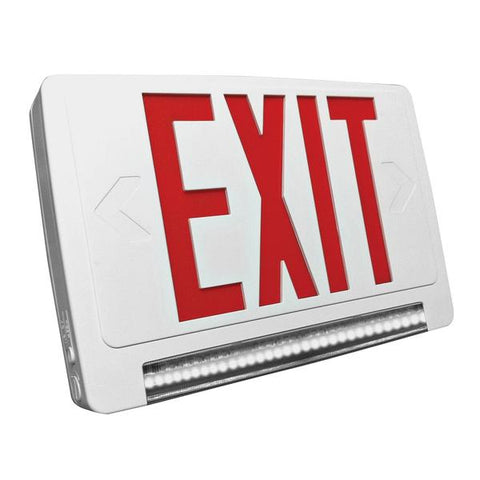
Exit Signs
LED exit signs are required in public buildings and workplaces, mounted over doors and along egress routes so they remain visible in a power outage or in smoke.
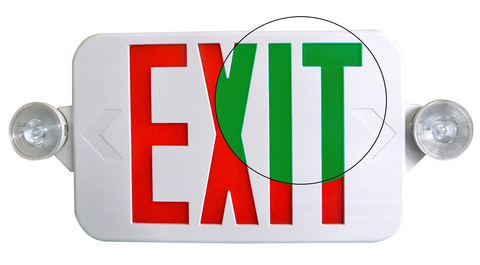
Check your lettering colour before ordering. This is the detail that most often causes a re-order. Some jurisdictions require red lettering, others mandate green, and the requirement is set locally rather than nationally. Confirm with your authority having jurisdiction rather than assuming.

Combination Exit Signs With Lights
A combination unit puts emergency lamp heads on the exit sign itself. When power fails, the sign stays lit and the heads illuminate the floor beneath it.
On most jobs this is the efficient choice: one device, one mounting point and one set of wiring satisfies both the marking requirement and the illumination requirement at the same location. Where a doorway needs both anyway, a combo unit usually costs less than two separate fixtures.
Code and Testing Requirements
This is the part that gets missed, and it is the part an inspector will ask about.
Ninety minutes of illumination
Life safety codes generally require emergency lighting to illuminate the means of egress for at least 90 minutes after a power failure. That figure drives battery sizing, and it is why an emergency fixture costs more than an ordinary one of the same output.
Monthly and annual testing
Emergency lighting is not install-and-forget. The commonly required regime is a brief functional test every month — usually 30 seconds via the test button, confirming the unit switches to battery and the lamps light — plus a full-duration test annually, running the unit for the whole 90 minutes to prove the battery still holds. Both should be logged, because the log is what gets inspected.
Fixtures with self-testing or self-diagnostic functions run those checks automatically and flag a fault with an indicator light. On a building with dozens of units, that pays for itself in labour alone.
Placement
Exit signs go where the route is not obvious as well as at the exits themselves, and emergency lighting has to cover the whole path of egress rather than just the doors. Specific requirements — spacing, mounting height, illumination levels, lettering size and colour — vary by adopted code edition and by jurisdiction, so confirm with your local authority having jurisdiction before finalising a package.
Why LED Has Replaced Everything Else
For emergency fixtures in particular, LED is not a marginal improvement. These units run continuously and have to work unattended for years, which is exactly where LED's advantages compound:
- Longer service life: LED exit signs typically run up to 10 years before the source needs attention, against frequent lamp changes on older technology. On a building with fifty signs, that is the difference between a routine job and a constant one.
- Far lower draw: exit signs are lit 24 hours a day, 365 days a year. LED consumes a fraction of the power of an incandescent equivalent, and on a large building the saving is measurable rather than theoretical.
- Smaller battery, longer backup: because the load is lower, the same battery holds the 90-minute requirement more comfortably.
- Cooler operation: less heat in the fixture means less stress on the battery, which is usually what fails first.
- No mercury: simpler disposal and no hazardous content.
If you have older fixtures still in service, replacing them with current LED exit signs and emergency units usually costs less over the life of the building than continuing to maintain what is there.
The Supporting Components
A few things worth specifying alongside the fixtures themselves:

Emergency Ballasts and Drivers
An emergency ballast or driver turns an ordinary fixture into an emergency one. It sits inside the housing, charges from mains, and on power loss drives the existing lamp at reduced output for the required duration.
This is often the cheaper route on a retrofit — rather than adding dedicated emergency fixtures, you convert fixtures that are already in the right places.

Power Inverters
Emergency lighting inverters work at the circuit level rather than the fixture level, converting DC battery power to AC so existing fixtures keep running through an outage.
They suit larger buildings where converting individual fixtures would be impractical, and where you want the normal lighting scheme to stay on rather than switching to a sparse emergency layout.
Protective Covers
In gymnasiums, warehouses with forklift traffic, or anywhere a fixture is exposed to impact, a wire guard or polycarbonate cover is a small cost against replacing the unit. Worth considering wherever a fixture sits within reach of moving equipment or a ball.
Frequently Asked Questions
How long do emergency lights have to stay on?
Life safety codes generally require at least 90 minutes of illumination along the means of egress after a power failure. That duration is what determines battery sizing in an emergency fixture. Confirm the requirement that applies to your building with your local authority having jurisdiction, since adopted code editions vary.
How often should emergency lighting be tested?
The usual regime is a brief functional test monthly — around 30 seconds using the test button, to confirm the unit switches to battery and the lamps illuminate — plus a full-duration test once a year, running the unit for the whole required period to prove the battery still holds charge. Keep a written log of both, because the log is generally what an inspector asks to see. Self-testing fixtures perform these checks automatically and indicate faults with a status light.
Should exit sign lettering be red or green?
It depends on your jurisdiction. Some require red, others mandate green, and it is set locally rather than by a single national standard. This is worth confirming before you order, because it is the most common reason an otherwise correct exit sign has to be sent back.
What is the difference between an exit sign and a combination unit?
An exit sign marks the route. A combination unit does that and adds emergency lamp heads that illuminate the floor beneath it during an outage. Where a doorway needs both marking and illumination — which is common — a combination unit is usually cheaper and simpler than installing two separate fixtures at the same location.
Can I convert existing fixtures instead of buying emergency ones?
Often, yes. An emergency ballast or driver fitted inside an existing fixture will run its lamp at reduced output on battery power during an outage, which converts a standard fixture into an emergency one. On a retrofit this is frequently cheaper than adding dedicated emergency fixtures, particularly where the existing fixtures are already positioned along the egress route. For larger buildings, a central inverter achieves the same at circuit level.
How long do LED exit signs last?
The LED source in a quality exit sign typically runs up to 10 years in continuous service. The battery is usually the component that needs attention first, which is what the annual full-duration test is designed to catch. Because exit signs are lit 24 hours a day, the reduction in both lamp changes and energy draw is where LED pays back against older technology.
Specifying Emergency Lighting for a Building?
Egress lighting is an inspection item, and the requirements vary by jurisdiction. Our specialists can help you work out fixture counts and placement along the egress path, confirm whether combination units or separate fixtures suit your doorways, and advise on converting existing fixtures with emergency ballasts. Send us your floor plan and we will work from it.
Shop Exit Signs & Emergency Lighting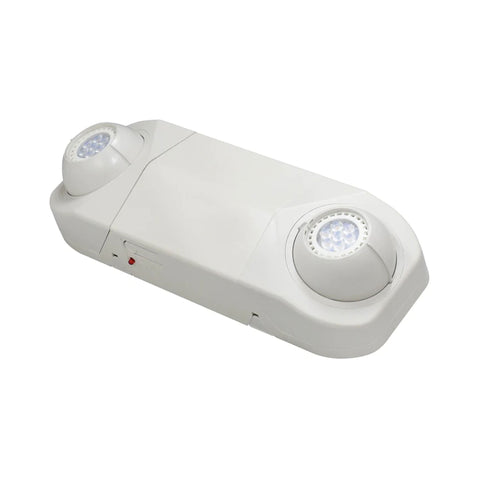
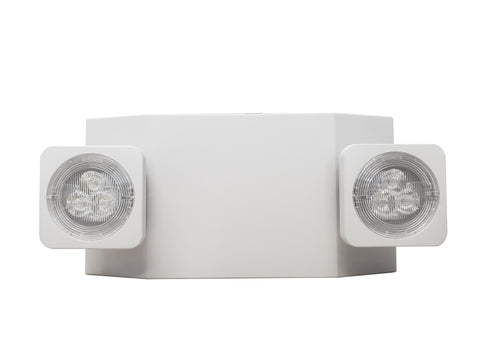
LED Reduced Profile Thermoplastic Emergency Unit with Two Adjustable Heads, White Finish

Emergency Lights and Exit Signs
Order emergency exit signs and led exit signs online from Warehouse Lighting. From slim profile to double faced, our emergency exit sign inventory has it all including exit signs with lights. Shop our diverse selection of emergency exit signs and lights online now at Warehouse-Lighting.com.
View (94) Products
Buy emergency lights online at Warehouse Lighting. Browse our selection of wall-mounted and ceiling-mounted commercial LED emergency light fixtures. Shop emergency lights for business and commercial applications online today.
View (33) Products
Exit Sign Emergency Light Combo
Shop for exit light combo fixtures online at Warehouse Lighting. Get the best of illumination and safety with our emergency exit combo lights. Choose from double and triple lamp options. Order Emergency exit lights combo fixtures today!
View (18) Products
Emergency Lighting Requirements for Commercial Buildings
As a business owner, there are certain elements of lighting that are paramount to a safe location for staff and customers. Let's take a look at what's required in emergency lighting for business...
Read Article
Rules Regarding Safety Lighting and Bulbs
Find out a few useful rules regarding safety lighting and bulbs to make the most of your location. We break down all the important areas right here.
Read Article
A Guide to Electrical Warehouse Light Fixtures
When it comes to lighting, it serves several purposes. The right lighting can help improve visibility in a workspace, eliminate accidents and injuries, and create a clean appearance to help set hig...
Read Article


