 High Bay LED Lighting
 Industrial Low Bay Lighting
 Industrial Strip Lights
 Vapor Tight Lighting
 LED Shop Lights
 LED Ready Fixtures
 Hazardous Area / Explosion Proof Lighting
 Loading Dock Lights
 Construction / Portable Lighting
 High Temperature LED Lights
 Industrial Ceiling Fans
 LED Work Lights
 Networked Controlled Lighting
 American Made Industrial Lighting
 Clearance
 Troffer Lights
 LED Flat Panel Lights
 Drop Ceiling Lights
 LED Ready Troffers
 Suspended LED Lights
 LED Cylinder Lights
 Stairway & Corridor Lighting
 Exit / Emergency
 Wrap Lighting Fixtures
 Gooseneck and Barn Lights
 Commercial Sign Lights
 LED Track Lighting Fixtures & Systems
 Recessed Lighting
 Wafer Lighting
 RGB LED Lights
 Hospital Bed Lights
 Refrigeration Lighting
 Grow Lights
 UV Disinfecting Lights & Air Purifier Fixtures
 American Made Commercial Lighting
 LED Flood Lights
 Outdoor Wall Lights
 LED Area Lights
 Parking Lot Lights & Poles
 Outdoor Post Top Lights
 LED Stadium Lighting
 Canopy Lights
 Security & Motion Sensor Lights
 LED Bollard Lights
 Outdoor LED Linear Light Fixtures
 Solar Powered LED Lighting
 Dusk to Dawn Lights
 Landscape Lighting
 Outdoor String Lights
 Coastal Wildlife Lighting
 Outdoor House Lights
 American Made Outdoor Lighting
 Architectural Linear Lights
 Architectural Grid Mount Lights
 Architectural Round Pendant Lights
 Architectural Square Linear Lights
 Architectural X-Shaped Linear Lights
 Architectural LED Wall Packs
 Ceiling Fans
 Ceiling Lights
 Chandelier Lights
 Pendant Lighting
 Island Lights
 Under Cabinet Lighting
 Vanity Lights
 Wall Sconces
 LED Tape Lights
 LED Mirrors
 LED Light Bulbs
 LED Tube Lights
 LED Corn Lights
 Vintage LED Bulbs
 Decorative LED Bulbs
 Fluorescent Light Bulbs
 Metal Halide Lamps
 LED Magnetic Strip Retrofit Kits
 LED Strip Light Retrofit Kits
 High Bay LED Retrofit Kits
 LED Troffer Retrofit Kits
 LED Wall Pack Retrofit
 LED Street Light Retrofit Kits
 Recessed Lighting LED Retrofit Kits
 WareSense Blue - Bluetooth Control System
 Ballasts & Drivers
 Emergency Ballast For LED & Fluorescent Lights
 Electrical Supplies & Mounting Kits
 Electrical Tools
 Switches & Receptacles
 Electrical Power Cords
 Sensors and Timers
 Smart Home Automation
 High Bay Occupancy Sensors
 Electric Vehicle Chargers
 Hand Dryers
 LED Shop Lights
 Office Lights
 Classroom Lights
 Church Lights
 Gym Lighting
 Factory Lights
 Hospital Lights
 Walkway Lights
 Parking Lot Lights
 Exterior Building Lights
 Sports Lighting
 Airport Lights
 Garage LED Lighting
 NSF Rated Lights
 TAA LED Lighting
 Restaurant Lights
 Corridor Lights
 Barn Lighting






Quick Answer: What Is Industrial Lighting?
Industrial lighting refers to heavy-duty light fixtures designed for warehouses, factories, manufacturing plants, and other high-demand work environments. Unlike standard commercial or residential lighting, industrial fixtures are built to withstand harsh conditions — extreme temperatures, dust, moisture, vibration, and continuous operation. The most common types include high bay lights, vapor tight fixtures, LED strip lights, and explosion proof lighting. LED is now the industry standard, delivering the highest lumen output per watt with the longest lifespan.
- High bay lights — for ceilings 20–40 ft; the backbone of warehouse and factory lighting
- Vapor tight fixtures — for wet, dusty, or corrosive environments like food processing and car washes
- Explosion proof lights — for hazardous locations with flammable gases or dust (Class I/II environments)
- LED strip lights — for low ceilings, assembly lines, and supplemental task lighting
Types of Industrial Lighting Fixtures
Industrial environments have unique demands that standard fixtures simply can't meet. Here are the primary fixture categories used in industrial settings and what makes each one the right choice for specific applications.
High Bay LED Lights
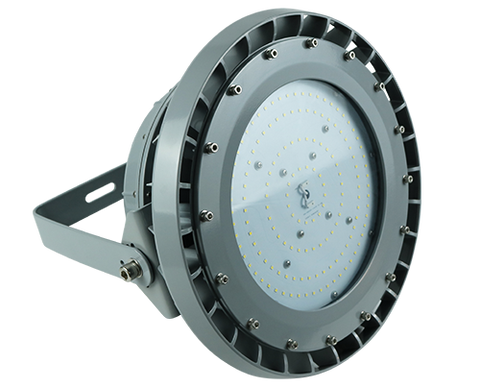
High bay lights are the most common industrial fixture. They're designed for ceiling heights of 20–40 feet and deliver powerful, downward-focused illumination across large open spaces. Two main styles dominate: UFO high bays (round, compact, 360° heat dissipation) and linear high bays (rectangular, ideal for aisle-style layouts). Most modern high bays range from 100W to 320W LED and are wattage-selectable, dimmable, and compatible with occupancy sensors. Best for: warehouses, factories, gyms, distribution centers, and big-box retail.
Vapor Tight Fixtures
Vapor tight lights are fully sealed against moisture, dust, and corrosive particles — rated IP65 or higher. The housing is typically a gasketed polycarbonate or aluminum enclosure with no gaps for contaminants to enter. They're the standard choice for food processing plants, car washes, parking garages, cold storage, and any wet or washdown environment. Available in 2-foot, 4-foot, and 8-foot lengths.
Explosion Proof Lighting
Required by code in Class I (flammable gases/vapors) and Class II (combustible dust) hazardous locations, explosion proof fixtures are engineered to contain any internal arc or spark within the fixture housing — preventing ignition of surrounding atmosphere. Common in oil refineries, chemical plants, grain storage, paint spray booths, and mining operations. These are among the most specialized and regulated industrial fixtures available.
LED Strip & Linear Lights
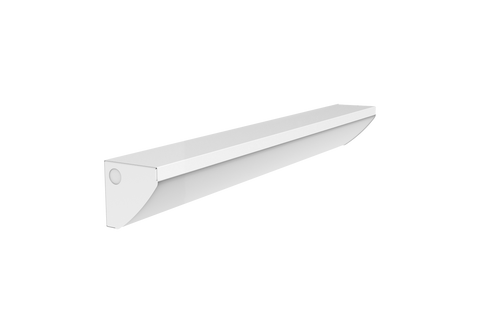
Industrial LED strip lights and linear fixtures provide bright, even illumination at lower mounting heights (under 20 feet). They're ideal for assembly lines, machine shops, workbenches, loading docks, and supplemental aisle lighting in warehouses. Available in 4-foot and 8-foot lengths, with linkable designs for continuous row lighting.
Low Bay Lights
Low bay fixtures are the industrial counterpart to high bays for ceiling heights under 20 feet. They distribute light more broadly with a wider beam angle, making them suitable for fabrication shops, auto repair centers, storage areas, and mezzanines. Generally range from 40W to 150W LED.
Industrial Lighting by Application
Your facility type determines which fixtures, mounting heights, lumen levels, and IP ratings you need. Explore our application-specific guides below.
Warehouse Lighting
High bay LEDs (100W–320W) for 20–40 ft ceilings. Typical target: 30–50 foot-candles at floor level. Motion sensors reduce energy by 30–50% in low-traffic zones.
Factory Lighting
Varies by task. Assembly lines need 50+ foot-candles. High-ceiling production floors use high bays; low-ceiling areas use linear or low bay fixtures.
Machine Shop Lighting
Precision work requires 75–100 foot-candles. Low bay or linear fixtures at 12–18 ft, supplemented by task lighting at individual stations.
Welding Shop Lighting
Welding creates bright arcs — fixtures must be positioned to minimize glare reflection. High CRI (80+) helps distinguish weld colors accurately.
Fabrication Workshop Lighting
Mixed-height environments often need both high bay and low bay fixtures. Vapor tight options recommended for metal cutting areas with coolant mist.
Auto Repair Center Lighting
Inspection bays need 100+ foot-candles. Combination of high bay overhead plus portable or pit lights for under-vehicle work.
Parking Garage Lighting
Vapor tight or canopy lights rated for damp locations. IES RP-20 recommends 5–10 foot-candles for general areas, 50 foot-candles at entrance/exit zones.
Explosion Proof Lighting
Required in Class I Div 1/2 and Class II Div 1/2 hazardous locations per NEC Article 500. UL Listed and rated fixtures mandatory.
How to Choose Industrial Lighting: A Buying Guide
Choosing the right industrial lighting comes down to four key variables. Get these right and everything else follows.
1. Ceiling Height
This is the single most important factor. Ceilings 20 feet and above require high bay fixtures — low bay or strip lights simply can't deliver adequate foot-candles at that distance. Ceilings under 20 feet use low bay or linear fixtures. Mixed-height facilities may need both. Measure from the floor to the lowest obstruction (beams, ducts) — not just the structural ceiling.
2. Required Foot-Candles (Light Level)
Different tasks require different light levels. OSHA and IES standards provide minimums: general warehouse storage needs 10–30 foot-candles; assembly work needs 50; fine inspection or machine work needs 75–100. Use a lighting calculator or consult a lighting expert to determine how many fixtures you need to hit your target uniformly across the space.
3. Environment & IP Rating
Wet, dusty, or chemically exposed environments require appropriate ingress protection. IP65 keeps out dust and low-pressure water jets (suitable for most industrial environments). IP66/67 handles high-pressure washdowns (food processing, car washes). Hazardous locations (flammable gases, combustible dust) require UL-listed explosion proof or intrinsically safe fixtures regardless of IP rating.
4. Color Temperature
For most industrial applications, 5000K (daylight) is the standard recommendation. It promotes alertness, improves contrast for safety and quality control, and most closely resembles natural daylight. In some environments — cold storage, certain manufacturing processes — 4000K (neutral white) is preferred. Avoid warm temperatures (2700K–3000K) in industrial settings as they reduce visual acuity.
Industrial Lighting Energy Best Practices
LED is now the clear choice for industrial settings — delivering 120–180 lumens per watt compared to 90 for induction, 60–80 for fluorescent T5, and 30–40 for metal halide. But the fixture is only part of the equation. These practices maximize your energy efficiency and ROI.
- Maximize natural light first. Bay openings, skylights, and translucent roof panels reduce daytime artificial lighting loads significantly. Orient workstations to take advantage of available daylight before adding fixtures.
- Install occupancy sensors. Motion sensors on high bay lights in low-traffic zones (storage aisles, dock areas) can reduce energy consumption by 30–50%. They're compatible with virtually all modern LED fixtures and typically pay for themselves within 12 months.
- Use dimmable fixtures with 0-10V controls. Dimmable LED high bays allow you to reduce output during low-activity periods or when daylight supplements the space — without sacrificing fixture lifespan.
- Invest in reflectors for older fluorescent retrofits. If retrofitting existing T5 or T8 strip fixtures, adding specular reflectors redirects wasted uplight downward, improving delivered foot-candles without adding wattage.
- Choose DLC Premium listed fixtures. DesignLights Consortium Premium listing qualifies your purchase for utility rebates in most states — often reducing net cost by 15–30%. Check with your utility before purchasing.
- Consider wattage-selectable fixtures. Many modern LED high bays offer multiple wattage settings (e.g., 150W/200W/240W) in one SKU. This lets you adjust output as your space or layout changes without replacing the fixture.
Frequently Asked Questions: Industrial Lighting
What type of lighting is best for industrial use?
LED high bay lights are the best choice for most industrial applications. They deliver 120–180 lumens per watt, last 50,000–100,000 hours, require no warm-up time, and work in extreme temperatures. For wet or corrosive environments, LED vapor tight fixtures are preferred. For hazardous locations with flammable gases or combustible dust, UL-listed explosion proof LED fixtures are required by code.
How many lumens do I need for a warehouse?
A typical warehouse requires 10–30 foot-candles (108–320 lux) for general storage and movement. For picking and packing areas, 30–50 foot-candles is recommended. To calculate lumens needed: multiply the square footage of the area by the target foot-candles, then account for fixture spacing and mounting height. A 10,000 sq ft warehouse targeting 30 foot-candles typically requires 8–12 high bay fixtures depending on wattage and mounting height.
What is the difference between high bay and low bay industrial lighting?
High bay fixtures are designed for ceilings 20 feet and above, using focused beam angles to deliver lumens over greater distances. Low bay fixtures work best for ceilings under 20 feet, spreading light more broadly. Using a high bay in a low-ceiling space creates glare and hotspots; using a low bay in a high-ceiling space results in inadequate floor illumination.
What is explosion proof lighting and when is it required?
Explosion proof lighting is a category of fixture engineered to contain any internal electrical arc or spark within the housing, preventing ignition of flammable or explosive surrounding atmospheres. It is required by the National Electrical Code (NEC) in Class I (flammable gas/vapor) and Class II (combustible dust) hazardous locations. Common applications include oil refineries, chemical plants, grain elevators, paint spray booths, and mining operations. Fixtures must be UL 844 listed for the specific hazardous location class and division.
How long do industrial LED lights last?
Quality industrial LED fixtures are rated for 50,000–100,000 hours of operation at L70 (the point at which output drops to 70% of original). At 16 hours of daily operation, a 50,000-hour fixture lasts approximately 8–9 years before needing replacement. This compares to 10,000–20,000 hours for metal halide and 30,000–50,000 hours for fluorescent T5HO — making LED the longest-lasting option by a significant margin.
Find the Right Industrial Lighting for Your Facility
Whether you're outfitting a new warehouse, upgrading a factory floor, or retrofitting aging fluorescent fixtures to LED, Warehouse-Lighting.com has the fixtures, expertise, and support to get it right. Our team can help you calculate your lighting needs, identify qualifying rebates, and select fixtures built for your specific environment.
Shop Industrial Lighting

